

How to Use AI for Essays and Research Papers Ethically and Responsibly

Pragya
⚡TL;DR Key Takeaways
- Check your assignment or course policy before using AI.
- Use AI to support learning, not replace your thinking.
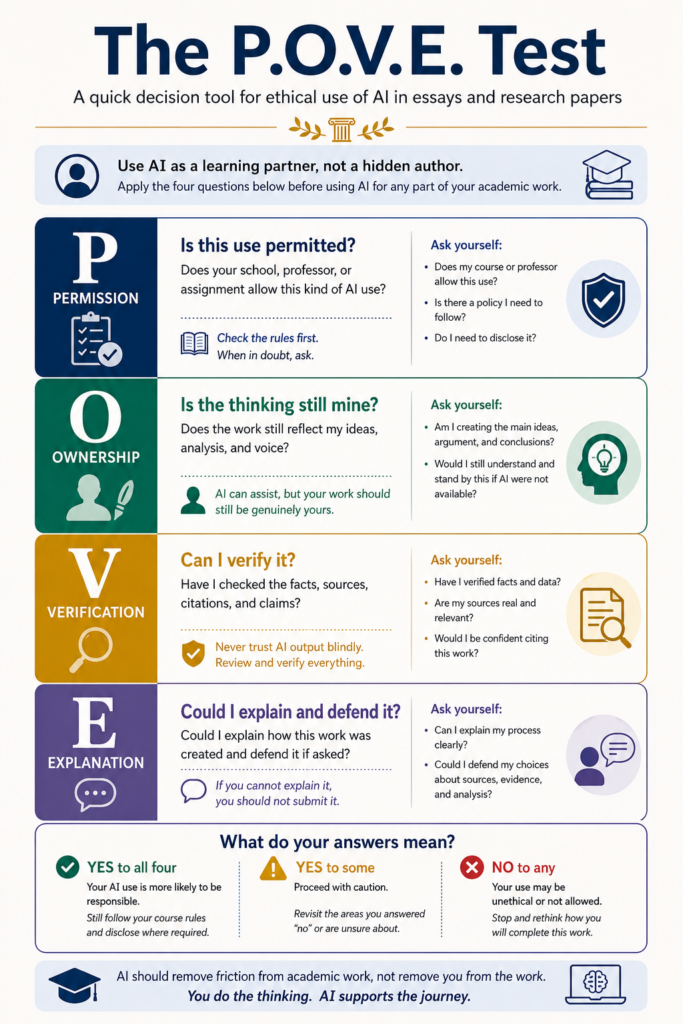
- Apply the P.O.V.E. Test: Permission, Ownership, Verification, and Explanation.
- Read every source you cite and verify every fact or quotation.
Table of contents58 sections
Use AI to understand difficult ideas, organize your research, and improve your writing—without giving away the thinking that makes the work yours.

You’re staring at a blank page.
The cursor is blinking with the confidence of someone who has contributed absolutely nothing to the assignment. Your notes look as though they were organized by a small tornado, the deadline is moving closer, and an AI tool is offering to write the entire essay before you finish making coffee.
The temptation is understandable.
But an essay was never meant to be a pile of polished sentences delivered before midnight. It is meant to show how you read, question evidence, connect ideas, and reach a conclusion you can defend.
Learning how to use AI for essays ethically means using it to understand difficult ideas, organize research, improve clarity, and strengthen your writing while keeping the argument, evidence, and final decisions genuinely yours.
AI use is responsible when it is permitted, the main thinking remains yours, the information is verified, and the assistance is disclosed when required.
Instant Essay Outline Generator
Struggling to structure your ideas? Type your essay topic below to generate a detailed, structured outline in the Conch AI study copilot.
AI may help you understand, organize, question, and revise your work. It should not become the hidden author of your argument, analysis, or final submission.
AI is a mirror, not a mind. It can reflect and sharpen what you bring to it. But when there is no real thinking underneath, the result may look polished while remaining strangely empty.
The goal is not to avoid AI.
The goal is to use it without disappearing from your own work.
TL;DR
- Check your assignment or course policy before using AI.
- Use AI to support learning, not replace your thinking.
- Apply the P.O.V.E. Test: Permission, Ownership, Verification, and Explanation.
- Read every source you cite and verify every fact or quotation.
- Disclose meaningful AI assistance when required.
- Keep your notes, drafts, and source records.
- Make sure you can explain and defend everything you submit.
What does ethical AI use in academic writing mean?
Ethical AI use means that the tool supports your learning without misrepresenting who performed the intellectual work.
It is not simply a question of whether AI touched the document. It is a question of what the tool did, what the assignment allowed, and whether the final paper honestly represents your understanding.
Using AI to explain an unfamiliar theory is different from asking it to invent your thesis.
Asking it to identify repetition in your outline is different from asking it to create your argument.
Using it to flag unclear sentences is different from submitting several generated paragraphs after changing a few adjectives.
The line is usually drawn around four responsibilities.
The P.O.V.E. Test for ethical AI use
Before using AI for any part of an essay or research paper, ask four questions.
P: Permission
Is this use permitted?
Check whether your school, professor, course, or assignment allows this kind of AI assistance.
One professor may permit brainstorming but prohibit AI-written paragraphs. Another may allow language editing but require a disclosure statement.
Do not assume that permission in one class applies to another.
When the rules are unclear, ask:
May I use an AI tool to review the structure of an outline I created myself if I write the argument and final text independently?
A specific question is more useful than simply asking, “Can I use AI?”
O: Ownership
Is the thinking still mine?
The central intellectual work should remain yours. That includes:
- Your research question
- Your thesis
- Your interpretation of evidence
- Your choice of sources
- Your counterarguments
- Your academic judgment
- Your conclusion
AI can question your reasoning, but it should not quietly manufacture the reasoning for you.
A sentence does not become intellectually yours simply because you changed a few words.
V: Verification
Can I verify the output?
AI can sound confident while being wrong.
It may produce an inaccurate fact, invent a source, misrepresent a study, or create a quotation that nobody actually wrote.
Your AI assistant is not a tiny professor living inside your laptop. It is a system generating likely language, and likely language is not the same as verified truth.
Check:
- Facts
- Statistics
- Authors
- Article titles
- Publication dates
- Quotations
- Page numbers
- Journal names
- Digital object identifiers
- Research findings
- Study limitations
If you cannot verify a statement, do not include it.
E: Explanation
Could I explain and defend it?
Imagine your professor points to a paragraph and asks:
- Why did you make this claim?
- Which source supports it?
- Why did you interpret the evidence this way?
- What limitation did you consider?
Could you answer clearly without opening the AI conversation?
If yes, AI probably remained in a supporting role.
If not, the tool may have taken over more of the assignment than you realized.
Check your institution’s policy first
There is no single AI rule followed by every university, department, professor, or academic journal.
Some courses prohibit generative AI completely. Some allow limited assistance. Others permit broader use when it is documented.
Your first responsibility is to check the rule that applies to the specific task.
Before opening an AI tool:
- Read the assignment instructions.
- Search the syllabus for “AI,” “generative AI,” or “academic integrity.”
- Check departmental or university guidance.
- Ask your instructor when the rule is unclear.
- Save any permission you receive.
Princeton’s current student guidance, for example, says students should determine whether and how AI is permitted and disclose permitted use according to course expectations.
Princeton’s guidance says students should first confirm whether AI use is permitted and disclose permitted use according to course expectations.
Lower-risk, conditional, and high-risk uses
| AI use | General risk | Better practice |
| Explaining a difficult term | Lower | Confirm the explanation using course material |
| Creating practice questions | Lower | Search academic databases yourself |
| Reviewing your outline | Lower | Ask for gaps or repetition, not a replacement outline |
| Summarizing a paper | Conditional | Read the original paper before citing it |
| Correcting grammar | Conditional | Check the course policy and preserve your meaning |
| Reorganizing notes | Conditional | Compare the output with your original notes |
| Rewriting a paragraph | Conditional to high | Ask for feedback before replacement text |
| Generating a thesis | High | Develop your own position from your reading |
| Writing the analysis | High | Write the interpretation yourself |
| Creating references | Very high | Find and verify every source independently |
| Hiding copied or generated work | Unethical | Rebuild the work from your research and understanding |
| Uploading confidential material | High | Use only approved tools and permitted information |
This table provides general guidance. Your course or assignment rules always take priority.
A responsible AI workflow for essays
Step 1: Understand the assignment yourself
Identify:
- The question
- The type of essay
- The assessment criteria
- The required evidence
- The citation style
- The permitted use of AI
Rewrite the assignment in your own words.
If you cannot explain the task, generated prose will only decorate the confusion.
Step 2: Record your initial thinking
Before using AI, write down:
- What you already think
- What you need to investigate
- Possible arguments
- Possible counterarguments
- Important theories or concepts
- Questions you still have
This creates a record of your intellectual starting point.
Step 3: Find real sources
Use:
- Your university library
- Academic databases
- Your course reading list
- Sources recommended by your instructor
- Official reports and publications
AI may help you find useful search terms.
A responsible prompt would be:
Suggest database keywords and Boolean search combinations for this research question. Do not invent sources or citations.
Step 4: Read the original material
An AI summary can help you approach a difficult article.
But a summary is a doorway, not the room.
Return to the original paper and check:
- What the researchers studied
- How the study was conducted
- What the study found
- What limitations the authors reported
- Whether the study actually supports your claim
Never cite a paper based only on an AI summary.
Step 5: Build your own outline
Connect each section of the outline to evidence you have read.
For every major paragraph, record:
- The claim
- The source
- The evidence
- Your interpretation
- A limitation or counterargument
You can then ask AI to review the structure without replacing it.
Step 6: Draft in your own words
Write from your notes rather than copying from the source sentence.
Your first draft does not need to be elegant. It needs to contain your understanding.
You can improve awkward writing later. It is much harder to recover ownership after the reasoning has been outsourced.
Step 7: Use AI as a reviewer
Useful prompts include:
“Identify the three places where my reasoning becomes unclear. Do not rewrite the paragraphs.”
“List claims that appear unsupported and explain what type of evidence each claim needs.”
“Does my conclusion answer the research question? Do not add new arguments.”
“Highlight sentences that are vague or unnecessarily long while preserving my meaning.”
These prompts produce feedback you can evaluate instead of ready-made text you may be tempted to paste.
Step 8: Verify every citation
Never trust a reference only because it looks professional.
Confirm:
- Author names
- Exact title
- Journal or publisher
- Publication year
- Volume and issue
- Page range
- DOI or stable link
- Quoted wording
- Whether the source supports your statement
A convincing-looking citation can still be imaginary.
Step 9: Revise for meaning
Focus on:
- Logical flow
- Evidence
- Accuracy
- Clear interpretation
- Correct attribution
- Natural academic language
- Your intended meaning
Do not revise only to manipulate an AI detector score.
Step 10: Document and disclose your use
- Keep Notes
- Outlines
- Source records
- Drafts
- Important prompts
- Relevant AI outputs
- Instructor permission
- Your disclosure statement
Better and riskier prompts
Developing a thesis
Riskier prompt
Write a strong thesis about social media and student mental health.
Better prompt
Here are three conclusions I reached from my sources. Ask me five questions that will help me decide which conclusion is most defensible. Do not write the thesis.
Reviewing an outline
Riskier prompt
Create a complete research-paper outline with arguments and references.
Better prompt
Here is the outline I created. Identify repeated points, unsupported sections, and missing counterarguments. Do not rewrite the outline or add sources.
Improving a paragraph
Riskier prompt
Rewrite this paragraph so it sounds advanced and academic.
Better prompt
Identify vague claims, weak transitions, and unnecessarily complicated sentences. Explain each problem without rewriting the paragraph.
Finding research
Riskier prompt
Give me ten academic sources that support my argument.
Better prompt
Suggest keywords, subject headings, and Boolean search combinations for locating peer-reviewed studies. Do not create citations.
How should researchers use AI ethically?
Research papers intended for publication involve additional responsibilities.
AI should not be listed as an author
The Committee on Publication Ethics states that AI tools cannot be authors because they cannot accept responsibility for a paper. Human authors remain accountable for accuracy, originality, and integrity.
The Committee on Publication Ethics states that AI tools cannot be listed as authors because they cannot accept responsibility for a paper.
Disclose meaningful assistance
The required disclosure method may depend on the journal, publisher, or academic discipline.
A tool used for language review may be acknowledged differently from a tool used during data analysis or figure creation.
Always check the target publication’s current instructions.
Protect confidential information
Do not upload sensitive material without permission, including:
- Unpublished manuscripts
- Peer-review reports
- Participant data
- Personal information
- Protected course materials
- Commercially sensitive research
Keep the research method transparent
Researchers should be able to explain:
- Which tool was used
- What version was used
- What information was entered
- What the tool produced
- How the output was checked
- Which decisions remained human
How to verify an AI-generated citation
1. Search the exact title
Put the title inside quotation marks and search:
- Your library database
- Google Scholar
- Crossref
- A subject database such as PubMed
No result is a warning sign.
2. Search the author separately
AI may combine a real author with an invented article.
Check the author’s institutional profile or publication record.
3. Open the real source
Do not rely only on a search preview or an AI summary.
Read the abstract and the full paper when available.
4. Find the supporting passage
A real article may still be irrelevant.
Confirm that the source supports the exact claim you are making.
5. Create the citation from verified details
Use information from the journal, publisher, library record, or DOI page.
APA Style provides guidance for referencing generative AI when the AI output itself is discussed or reproduced. Citation, permission, and disclosure are still separate questions.
Can an AI detector prove who wrote an essay?
An AI detector cannot directly observe the writing process.
It examines patterns in the submitted text and estimates whether parts resemble machine-generated writing.
False positives are possible. Turnitin’s guidance says results below 20 percent are treated as less reliable and should not be used as the sole basis for action against a student.
This does not mean students should try to beat detectors.
It means the strongest evidence of genuine authorship is often the visible writing process:
- Notes
- Sources
- Outlines
- Draft history
- Version changes
- The ability to explain the argument
Turnitin’s guidance explains that lower-percentage AI results are less reliable and should be interpreted carefully. Turnitin also states that an AI writing score should not be used as the sole basis for taking action against a student.
Is using an AI humanizer unethical?
Not automatically.
The ethical question is not simply whether a tool changed the sentence structure. It is whose thinking the revised text represents and why the tool was used.
Using a language tool to improve clarity in a paragraph you researched and wrote may be acceptable when your course permits it.
Using a humanizer to disguise a generated essay or conceal unauthorized assistance crosses the line.
A rewritten sentence does not become intellectually yours when the argument, analysis, and evidence were created elsewhere.
Use humanization to improve authentic expression, not to manufacture the appearance of authentic authorship.
AI disclosure statement templates
Student essay template
AI use statement: I used [tool and version, where available] on [date or date range] to [describe the permitted task, such as reviewing my outline, suggesting search keywords, or identifying unclear sentences]. I evaluated and revised all suggestions. The source selection, verification, argument, analysis, and final submission remain my responsibility.
Research-paper template
AI use statement: The authors used [tool and version] during [research stage] for [specific purpose]. The tool received [general description of the input]. Its output was checked using [method]. No confidential participant information was entered. All methodological decisions, interpretations, and conclusions were made and reviewed by the authors.
Short disclosure
I used [tool] to review sentence clarity and identify repetition. I wrote and verified the final content.
Always follow the disclosure format required by your instructor, university, journal, or publisher.
For formal reference formats, see APA Style’s examples for AI references.
Worked example: Maya’s responsible AI workflow
Maya has a 2,000-word sociology essay due in five days.
She begins with:
- The assignment instructions
- Four academic papers she has read
- Handwritten notes
- A tentative thesis
- A rough outline
She uses AI to:
- Ask questions about a theory she finds difficult
- Identify repetition in her outline
- Mark claims that need more evidence
- Flag long or unclear sentences
- Turn her professor’s comments into revision questions
She does not use AI to:
- Choose her position
- Invent evidence
- Generate examples
- Write the analysis
- Create citations
- Produce the final paper
Before submitting, Maya checks every source, saves her drafts, and adds a disclosure because her course requires one.
The AI reduced friction.
Maya still performed the work being assessed.
Related Reading
- How to Calculate H Index
- Technology Essay
- How to Write a Header for an Essay
- How to Write a Biography Essay
- How to Write a Reflection Paper
- How to Write an Encyclopedia Entry
- Speech Analysis Example
- What is a Good H Index
How Conch can support an ethical academic workflow
A responsible Conch workflow begins with material created or selected by the student:
- Assignment instructions
- Research notes
- Sources
- A tentative argument
- An outline or draft
Then:
- Bring your notes, evidence, and initial thinking to Conch.
- Use Conch to organize ideas or review the structure.
- Ask Conch to identify unclear, repetitive, or unnatural wording.
- Evaluate each suggestion rather than accepting everything automatically.
- Compare the final meaning with your original evidence.
- Verify facts and citations independently.
- Disclose the assistance when required.
- Make the final academic decisions yourself.
Conch helps remove friction from academic work without removing the student from the work.
That is the difference between a learning partner and a hidden author.
Common mistakes to avoid
| Mistake | Why it creates risk | Better approach |
| Assuming all AI use is allowed | Rules differ by assignment | Check the course policy |
| Asking AI to create the thesis | Transfers a central thinking task | Form your position from your reading |
| Trusting formatted references | A realistic citation may still be false | Verify every source |
| Editing only for detector scores | Encourages surface manipulation | Revise for accuracy and ownership |
| Uploading unpublished material | May create privacy risks | Use approved tools and information |
| Hiding meaningful AI use | May violate disclosure rules | Explain the tool and purpose |
| Accepting every rewrite | May change meaning or voice | Review each suggestion carefully |
| Citing an AI summary | The summary is not the original evidence | Read and cite the source |
Ethical AI submission checklist
Before submitting, confirm:
- I checked the AI rules for this assignment.
- I can explain exactly how AI helped.
- I created the central thesis or research claim.
- I selected and read the sources.
- I verified every fact, quotation, and citation.
- I wrote or meaningfully developed the analysis.
- I checked that editing did not change my meaning.
- I did not upload confidential or protected information.
- I disclosed AI assistance when required.
- I saved my notes, drafts, and relevant prompts.
- I can defend the paper without relying on the AI tool.
When one item remains uncertain, pause before submitting.
Your deadline may be impatient. Academic consequences are usually more patient.
Use the P.O.V.E. Test:
Frequently asked questions
Is using AI to check grammar cheating?
Not automatically. Grammar and clarity assistance may be acceptable when your assignment permits it. Some instructors may still require disclosure, so check the specific rule.
Can AI help me understand a research paper?
Yes, when your rules allow it. Treat the explanation as a reading aid, then return to the original paper before citing its findings or limitations.
Can AI create my essay outline?
AI can review or organize an outline based on your own notes when permitted. Create your initial thesis, evidence plan, and structure first.
Is using AI for an essay plagiarism?
AI use is not automatically plagiarism. However, unauthorized, undisclosed, or copied generated material may still violate academic-integrity rules.
Can I cite ChatGPT or another AI tool?
You can cite generative AI output when your style guide and context require it. Citing the tool does not make prohibited use acceptable.
Could an AI detector flag writing I wrote myself?
Yes. False positives are possible. Keep your drafts and process evidence rather than trying to manipulate the score.
Should I save my prompts?
Yes. Relevant prompts can help you prepare an accurate disclosure and explain what the tool contributed.
What should I do when the policy is unclear?
Ask your instructor a specific question describing the tool, the task, and how you plan to use it. Save the reply.
The bottom line
AI can make difficult reading less intimidating. It can organize a crowded outline, expose a weak transition, or help a student express an idea more clearly.
What it cannot ethically do is accept responsibility for your research, judgment, or argument.
Use AI to ask better questions.
Use it to notice what you missed.
Use it to remove unnecessary friction.
But keep the part that matters most: “The thinking.”
Bring your notes, sources, and draft to Conch to review structure, clarity, and academic expression—then verify the evidence and make the final decisions yourself.

About the Author: PragyaVerified Editor
Academic Policy Specialist & AI Ethics Researcher
Pragya is a learning specialist and content editor focusing on student productivity, academic integrity, and responsible AI integration. They hold extensive experience guiding students through research standards, citation guidelines, and text refinement workflows.