
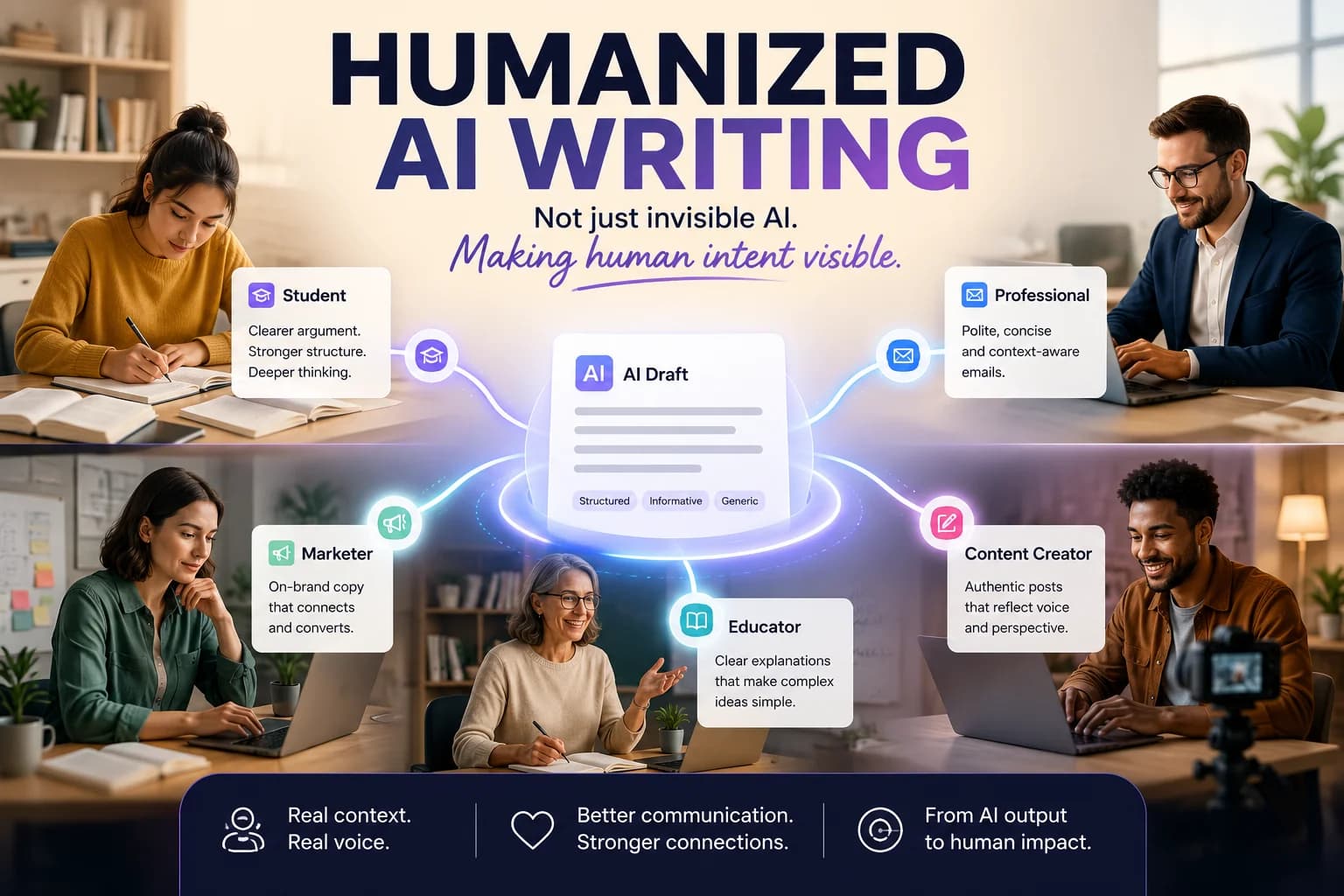
Humanized AI Writing Is More Than AI Detection

Pragya
⚡TL;DR Key Takeaways
- Humanized AI writing goes beyond detection.
- Explore 10 practical uses for essays, emails, applications, marketing, reports, and more.
- Humanized AI writing is often treated like a technical trick.
Table of contents51 sections
Humanized AI writing is often treated like a technical trick.
You give AI-generated text a few new words. You change the rhythm. Then you hope it looks less mechanical.
But that is a very small use for a much bigger idea.
You ask AI to write an email.
It writes a very good email. In fact, it writes the kind of email that has never missed a deadline and probably has excellent posture.
Every comma is in place. The tone is polite. The structure is neat.
Free Readability and Tone Diagnostic
Check if your draft sounds natural and clear. Paste a paragraph below to simulate readability scoring and tone analysis.
Still, your finger pauses over the send button.
Something feels wrong.
Not grammatically wrong.
Humanly wrong.
The email sounds like someone arriving at a coffee meeting in a three-piece suit with a printed agenda.
Respectable? Yes.
Appropriate? Not quite.
The AI knows you want to ask for Friday off. However, it does not know that your manager heard about it yesterday. It does not know that you usually exchange three-line messages.
It also does not know that “Dear Mr. Sharma” would make both of you wonder whether the company had suddenly been nationalized.
It knows the task.
It does not know the life around the task.
That small difference changes everything.
The same problem appears in essays, applications, reports, marketing copy, and customer messages.
AI may polish an essay until it sounds more academic. Yet one sentence may become more confident than the evidence allows.
It may write a professional cover letter. Unfortunately, that letter could belong to you, your classmate, your neighbor, or a highly motivated refrigerator.
It may create a polite customer reply. Still, the customer may finish reading without knowing what happened or what the company will do next.
These are humanization problems.
And none of them requires an AI detector.
For years, people have asked:
Can we make AI-generated text look as though a human wrote it?
That question created traffic, tools, anxiety, and many enthusiastic promises.
However, it also reduced humanization to camouflage.
It assumed that the main reason to sound human was to hide the machine.
But human writing is not valuable because it can fool a detector.
It is valuable because it carries context.
It carries memory.
It carries hesitation.
It carries judgment.
Sometimes, it carries a badly placed joke that only one person will understand.
In education, it carries something more.
It carries a conversation between the student and the teacher.
An assignment is not only a grammatically correct, evidence-based document submitted before midnight.
It is also one of the few places where a teacher can see how a student thinks.
The argument shows what the student understood.
The examples show what they noticed.
The questions show where they remain uncertain.
Even the mistakes can be useful. They reveal where learning has paused and where better guidance may help.
A teacher does not only check commas, citations, and paragraph structure.
At their best, teachers read for depth, seriousness, curiosity, and effort.
The assignment becomes a message:
This is how I understand the subject.
This is how far I have thought about it.
This is where I may still need help.
The teacher’s response continues that conversation.
It may confirm strong reasoning. It may challenge a weak assumption. It may reveal something the student could not yet see alone.
Therefore, an essay should not become a polished wall between the student and the teacher.
It should remain a window into the student’s thinking.
If AI improves the grammar but removes the uncertainty, struggle, interpretation, and original thought, the essay may look stronger.
At the same time, the learning becomes harder to see.
That is where humanized writing comes in.
Humanized writing does not ask students to reject AI. Instead, it asks them to use AI with greater care.
AI can organize scattered thoughts. It can improve academic language. It can strengthen transitions and identify gaps.
As a result, students may have more time for reflection, revision, and deeper learning.
However, AI should not replace the student’s thinking with a smoother version of someone else’s language.
The purpose is to help students express their own thinking more clearly.
Humanized writing keeps the intent while improving the expression.
It keeps the argument while making the structure easier to follow.
It also keeps uncertainty where uncertainty is honest.
In other words, AI can elevate the writing without making the student disappear.
This principle applies far beyond education.
Humanized AI writing can improve emails, job applications, reports, marketing content, translations, social posts, and customer communication.
So, the better question is not:
Can I make this look human?
It is:
Can I make this communicate like a person who understands the meaning, the reader, and the moment?
The purpose is not to make AI invisible.
The purpose is to make human intention visible.
What Is Humanized AI Writing?
Humanized AI writing is text revised to better fit the writer, the reader, and the situation.
The starting point may be an AI draft. It may also be your notes, a translation, a rough paragraph, or an overly formal document.
Humanizing the text may involve improving:
- tone;
- clarity;
- sentence rhythm;
- vocabulary;
- structure;
- formality;
- specificity;
- examples;
- audience fit.
However, humanization is not a synonym lottery.
It is not adding a personal story that never happened.
It is not making every sentence casual.
Most importantly, it is not changing the text until a detector gives you a preferred score.
A useful definition is:
Humanized AI writing is AI-assisted text refined to preserve meaning while making the language more natural, specific, appropriate, and useful.
That shifts the goal from:
Change the words.
to:
Make the communication fit the human situation.
Related Reading
- How to Calculate H Index
- How to Write an Informative Essay
- Technology Essay
- How to Write a Header for an Essay
- How to Write a Biography Essay
- How to Write a Reflection Paper
- How to Write an Encyclopedia Entry
- Speech Analysis Example
- What is a Good H Index
- How to improve Academic Writing
Why Perfect AI Writing Can Still Feel Wrong
AI can produce fluent language in seconds.
However, fluency does not guarantee good communication.
A sentence may be grammatically correct while still being:
- too formal for the relationship;
- too vague to be useful;
- too confident for the evidence;
- too generic to be memorable;
- too polished to sound like the writer;
- too complex for the audience;
- too emotionally flat for the situation.
This happens because communication contains information that a prompt may never capture.
For example, imagine you ask AI to write an email requesting Friday off.
The AI understands the task.
Yet it may not know that:
- your manager prefers short messages;
- you mentioned the request yesterday;
- Friday is your quietest day;
- you finished the week’s urgent work;
- your company communicates casually;
- you want to sound responsible, not apologetic.
Those details shape the right message.
Therefore, humanized AI writing is not only a language issue.
It is a context issue.
AI produces language.
Humans supply the situation.
The Five Layers of Humanized AI Writing
Useful humanization should improve more than fluency.
It should protect five parts of communication.
1. Meaning
First, ask whether the revision still says what you meant.
A smoother sentence is not an improvement if it changes the claim.
Original
The study found an association between screen time and sleep quality.
Inaccurate rewrite
The study proved that screen time causes poor sleep.
The second sentence sounds more confident.
However, it says something different.
An association does not automatically prove causation.
Therefore, humanized academic writing should never trade accuracy for confidence.
2. Voice
Next, ask whether the language fits the person speaking.
Voice does not mean adding slang.
A researcher can sound natural while remaining formal. A founder can sound human without becoming casual.
Likewise, a student can write academically without pretending to be a journal editor.
Good humanization improves expression while preserving identity.
3. Context
Then, ask whether the text fits the situation.
Compare:
Please provide the requested document at your earliest convenience.
with:
Could you send me the updated spreadsheet before our 2 p.m. review?
The second version is not better only because it uses simpler words.
It is better because it knows what the reader needs to do.
Context creates usefulness.
4. Specificity
Generic writing rarely feels personal.
Compare:
I am passionate about marketing and have excellent communication skills.
with:
Last semester, I promoted three student events. Short testimonial videos brought us more registrations than poster-only campaigns.
One sentence describes a type of applicant.
The other describes a person.
Specificity is one of the strongest ways to humanize AI text.
5. Reader Awareness
Finally, ask what the reader needs.
A professor may need precise reasoning.
A customer needs an answer.
A recruiter needs evidence.
A busy manager needs the decision first.
A beginner needs a clear explanation.
Therefore, humanized writing is not simply more conversational.
It is more reader-aware.
10 Productive Uses of Humanized AI Writing
1. Humanize Professional Emails
Email is one of the clearest uses of humanized AI writing.
Small tone problems become obvious very quickly.
Imagine you want to confirm a deadline.
AI version
Dear Mr. Thompson,
I hope this message finds you well. I am writing to inquire whether the project deadline remains Friday. Your clarification would be appreciated.
Nothing is technically wrong.
Yet your manager normally writes:
Can you send me the figures before lunch?
The AI draft creates social distance that does not exist.
Humanized version
Hi Sam,
Just checking whether the revised files are still due Friday. I want to make sure I’m working toward the right deadline.
Thanks.
This version works better for three reasons.
First, it asks the question early.
Second, it explains why the answer matters.
Finally, it fits the relationship.
Better prompt
Make this email concise and warm. I know my manager well. We use first names and short messages. Keep the request direct.
Humanization job: Make the email fit the relationship.
2. Humanize Academic Writing Without Removing the Student
Academic writing is one of the most valuable uses of humanization.
However, the goal should not be to make a fully AI-written assignment appear independently written.
The productive goal is to help students express their own reasoning with greater clarity.
Consider this sentence:
People who sleep less get bad marks because the research proves sleep affects grades.
The student’s actual understanding may be more careful.
A better version is:
The findings suggest a relationship between shorter sleep duration and lower academic performance. However, they do not prove a direct causal link.
This is not only better English.
It protects the exact level of certainty in the evidence.
A productive workflow looks like this:
Student’s idea
↓
Student’s evidence
↓
Student’s rough explanation
↓
AI-assisted language improvement
↓
Student’s accuracy check
Do not reverse the process.
The student should form the idea before asking AI to improve the language.
AI can help students:
- organize notes;
- improve sentence clarity;
- strengthen transitions;
- find repetition;
- explain difficult terms;
- adjust academic tone;
- identify missing evidence;
- compare a draft with a rubric.
However, the student remains responsible for:
- the argument;
- interpretation;
- evidence;
- sources;
- citations;
- factual accuracy;
- course requirements;
- final submission.
Humanization job: Improve academic expression while preserving the student’s thinking.
3. Improve Cover Letters and Applications
AI can write a respectable cover letter in seconds.
That is part of the problem.
Generic version
I am excited to apply for the Marketing Intern position. My passion for marketing and strong communication skills make me an excellent candidate.
It sounds professional.
However, almost any applicant could use it.
Humanized version
I noticed that the internship involves creator partnerships, which drew me to the role. Last semester, I promoted events for our university entrepreneurship club. I especially enjoyed testing which posts turned views into registrations.
Now the recruiter learns:
- why you chose the role;
- what you have done;
- what interested you;
- how your experience connects to the job.
AI cannot responsibly invent those facts.
You must supply them.
Better prompt
Use the job description and my notes below. Connect my real experience to the role. Do not add achievements, numbers, or responsibilities I have not provided.
Humanization job: Replace generic praise with evidence and motivation.
4. Make Customer Support More Useful
Many support messages sound polite without solving anything.
Generic version
We sincerely apologize for any inconvenience. We appreciate your patience while we work to resolve the matter.
The customer still does not know what happened.
Humanized version
I’m sorry your order has not arrived. The tracking has not updated since Tuesday. I have asked our delivery team to investigate. We will email you again by 3 p.m. tomorrow.
The second version works because empathy connects to action.
A useful support message should include:
acknowledgment + information + action + expectation
Humanization should not make a bot pretend harder to be a person.
Instead, it should make the response clearer and more useful.
Humanization job: Turn polite language into a helpful answer.
5. Restore Brand Voice to Marketing Copy
Ask several AI tools to describe a productivity app.
You may see phrases such as:
Streamline your workflow.
Boost productivity.
Reach your full potential.
Work smarter, not harder.
These phrases are not always wrong.
Unfortunately, almost any brand could use them.
Generic version
Our platform helps students streamline their academic workflow and maximize productivity.
Humanized version
Your notes are in one tab. The assignment brief is in another. Three PDFs are open, and you still do not know what paragraph one should argue. Conch Ai helps turn that mess into a workable writing flow.
The second version contains a recognizable situation.
As a result, the reader can see themselves in it.
To humanize marketing copy, add:
- real customer language;
- a clear point of view;
- actual product behavior;
- specific situations;
- evidence.
Humanization is not sprinkling personality over generic copy.
It is replacing abstraction with real customer understanding.
Humanization job: Turn category language into brand meaning.
6. Make Reports Easier to Act On
Humanized writing does not always mean warmer writing.
Sometimes, it means respecting the reader’s time.
Before
The successful implementation of this initiative will require significant cross-functional collaboration between multiple stakeholders.
After
Product, marketing, and support need to coordinate before launch.
The meaning remains.
The reader reaches it faster.
This type of humanization works well for:
- reports;
- proposals;
- executive summaries;
- internal updates;
- project documents;
- meeting notes.
Professional writing does not need to sound casual.
It needs to make the next decision easier.
Humanization job: Turn formal, wordy text into decision-ready communication.
7. Keep Your Personality in Social Content
AI helps creators turn one idea into several formats.
A single idea can become:
- a LinkedIn post;
- a newsletter section;
- a video script;
- several short posts;
- an Instagram caption.
That saves time.
However, it also creates a risk.
The creator may disappear.
Generic version
Leadership is not about having all the answers. It is about empowering your team to succeed.
The sentence is competent.
But who is speaking?
Better raw material
Yesterday, I rejected a campaign idea. Ten minutes later, I realized I had misunderstood the data. I changed my mind in front of the team. The meeting became more productive after that.
Now AI has something human to work with:
- an event;
- a mistake;
- a reaction;
- an opinion;
- a lesson.
The prompt contains life before it contains language.
Humanization job: Scale the format without removing the person.
8. Improve Translated Writing
Translation answers:
What does this mean in another language?
Humanization asks:
How would someone normally communicate this meaning in this situation?
Consider:
Kindly do the needful at the earliest.
This may feel natural in one professional culture.
For another audience, the writer may prefer:
Could you send the corrected file by Thursday?
Neither sentence is automatically more human.
The second may simply fit the audience better.
A useful multilingual workflow is:
Think in the language that best expresses the idea.
↓
Translate the meaning.
↓
Adapt the wording to the audience.
↓
Check it against the original meaning.
The goal is not to erase linguistic identity.
The goal is mutual understanding.
Humanization job: Translate social meaning, not only words.
9. Explain Difficult Ideas More Clearly
Imagine AI produces this sentence:
Photosynthesis is the biochemical mechanism through which photoautotrophic organisms convert electromagnetic radiation into chemical energy.
It may be accurate.
However, it will not help every reader.
For a high-school student
Photosynthesis is the process plants use to turn light energy into stored chemical energy.
For a younger learner
Plants use sunlight to help make the food they need to grow.
The idea remains connected.
The explanation changes because the reader changes.
This can help:
- teachers;
- students;
- researchers;
- journalists;
- professionals;
- customer-facing teams.
However, simplification requires care.
If you remove too much detail, clarity becomes inaccuracy.
Humanization job: Match complexity to the reader without changing the facts.
10. Protect Your Voice While Co-Writing With AI
The best humanization may happen before the AI draft becomes generic.
Instead of:
AI writes everything → humanizer rewrites everything
use:
Human decides → AI assists → human selects → AI refines → human verifies
This matters because AI can influence more than wording.
A confident suggestion may begin shaping your argument before you have developed it.
Therefore, decide the important points first.
You can begin with:
- rough notes;
- a voice recording;
- an argument;
- evidence;
- an example;
- a personal observation;
- a question.
Then, ask AI to organize or refine that material.
Humanization job: Keep AI in the supporting role.
Humanized AI Writing Is Not Undetectable Writing
This distinction matters.
Productive humanization should not depend on hiding prohibited AI use.
Responsible Humanization
Make this email direct but friendly.
Improve the academic wording without strengthening my claim.
Make this report easier to scan.
Use these brand examples to improve the tone.
Explain this paragraph for a first-year student.
Misleading Humanization
Make this assignment look independently written when it was not.
Invent a personal story for my application.
Rewrite prohibited AI-generated coursework so it cannot be identified.
One improves communication.
The other creates a false impression of authorship or experience.
They are not the same goal.
Humanization should help people communicate their own meaning.
It should not manufacture a person who was never present in the work.
A Four-Step Humanized Writing Framework
Use this workflow for almost any AI-assisted draft.
Step 1: Think
Before generating text, answer:
- What do I mean?
- Who will read this?
- What matters to them?
- What should happen next?
- Which facts must remain accurate?
Even one minute of thinking can improve the result.
Step 2: Draft
Next, create a starting version.
You can:
- write it yourself;
- provide notes;
- dictate your ideas;
- ask AI to organize information;
- generate a basic structure.
At this stage, focus on substance.
Step 3: Humanize
Review five areas:
Meaning: Did anything change?
Voice: Does it sound like you?
Context: Does it fit the reader?
Specificity: Can you add real detail?
Reader value: Is the useful point easy to find?
Step 4: Verify
Before sending or publishing:
- check factual claims;
- verify names and numbers;
- open important sources;
- review quotations;
- remove invented details;
- check the level of certainty;
- follow relevant AI-use rules;
- make the final decision yourself.
A sentence can sound natural and still be wrong.
How Conch Ai Can Support Humanized AI Writing
Conch Ai can act as an editing and learning layer.
The useful process is not:
Paste → humanize → trust everything.
Instead, use this workflow.
Bring Real Input
Start with your notes, argument, evidence, experience, or source material.
Identify the Real Writing Problem
Do you need:
- clearer wording;
- more natural flow;
- academic language;
- simpler explanations;
- a shorter version;
- a more formal tone;
- better structure?
A precise request produces a more useful revision.
Review the Output
Check whether the final version still contains:
- your meaning;
- your facts;
- your level of certainty;
- your voice;
- the right tone.
Add What AI Cannot Know
This may include:
- what happened in a meeting;
- why you care about a job;
- how your teacher framed the assignment;
- what the customer already tried;
- what your brand believes;
- what you genuinely think.
Conch Ai can improve expression.
The writer must still supply the life around the words.
The 60-Second Humanization Test
Before using AI-assisted writing, ask six questions.
Could This Have Been Written for Anybody?
If yes, add a real example, detail, or observation.
Does It Fit the Relationship?
A professor, colleague, customer, recruiter, and friend require different language.
Did AI Make the Claim Stronger?
Watch words such as:
- proves;
- always;
- definitely;
- causes;
- guarantees;
- clearly.
Use them only when the evidence supports them.
Is There a Real Person or Situation in the Text?
Add context where it helps.
Do not invent it.
Can the Reader Find the Point Quickly?
If not, move the important information earlier.
Would You Stand Behind Every Sentence?
If not, the draft is not finished.
Frequently Asked Questions
What is humanized AI writing?
Humanized AI writing is AI-assisted text revised to better fit the writer’s meaning, voice, context, audience, and communication goal.
Why does AI writing sound robotic?
AI writing may sound robotic when it lacks real context, specific details, varied rhythm, personal judgment, or awareness of the relationship.
Is humanizing AI text the same as paraphrasing?
No. Paraphrasing mainly changes wording. Humanization also considers voice, context, tone, specificity, and audience.
Can humanized AI writing help students?
Yes. It can improve clarity, structure, academic language, and transitions. However, students should keep control of the argument, evidence, and final meaning.
Can it help non-native English writers?
Yes. It can improve fluency and audience fit. Still, the writer should check that the meaning remains accurate.
Does humanized writing have to sound casual?
No. Humanized writing should sound appropriate, not necessarily informal.
Should I use a humanizer to bypass detection?
No. Humanization should improve communication, not conceal prohibited AI assistance.
AI Made Polished Text Easy. Human Context Became More Valuable
For years, writing tools focused on better sentences.
Generative AI changed that problem.
A polished paragraph is now easy to produce.
Therefore, polished language alone is less distinctive.
What becomes more valuable?
- a real point of view;
- specific experience;
- accurate evidence;
- knowledge of the reader;
- cultural context;
- judgment;
- taste;
- responsibility.
That is why humanized AI writing should be bigger than AI detection.
It can help a student express a complex idea without losing its meaning.
It can help an international professional communicate across languages.
It can turn a mechanical apology into useful customer support.
It can make a report easier to act on.
It can help a creator publish more without disappearing from their own content.
Most importantly, it can create a better relationship between humans and AI.
Not:
AI writes. The human hides the AI.
But:
The human thinks. AI assists. The human improves. The human decides.
That is a much more valuable reason to humanize writing.
Make the Draft Sound Like the Communication You Intended
Use Conch Ai to improve clarity, tone, readability, and flow.
However, treat the result as an editing layer.
It should not replace your facts, reasoning, context, or judgment.
Your meaning should survive the rewrite.
Your voice should become clearer, not disappear.
Related Reading

About the Author: PragyaVerified Editor
Academic Policy Specialist & AI Ethics Researcher
Pragya is a learning specialist and content editor focusing on student productivity, academic integrity, and responsible AI integration. They hold extensive experience guiding students through research standards, citation guidelines, and text refinement workflows.