
AI for Students: 9 Smart Ways to Learn Better in 2026

Pragya
⚡TL;DR Key Takeaways
- AI can turn notes, chapters and permitted PDFs into flashcards, mind maps, quizzes, notes and audio lessons.
- Students learn more when AI asks them to retrieve, explain and apply information instead of simply giving them an answer.
- International students can use multilingual audio as a bridge between understanding a topic and expressing it in academic English.
- AI writing support should improve a student’s real ideas rather than inventing arguments on the student’s behalf.
Table of contents81 sections
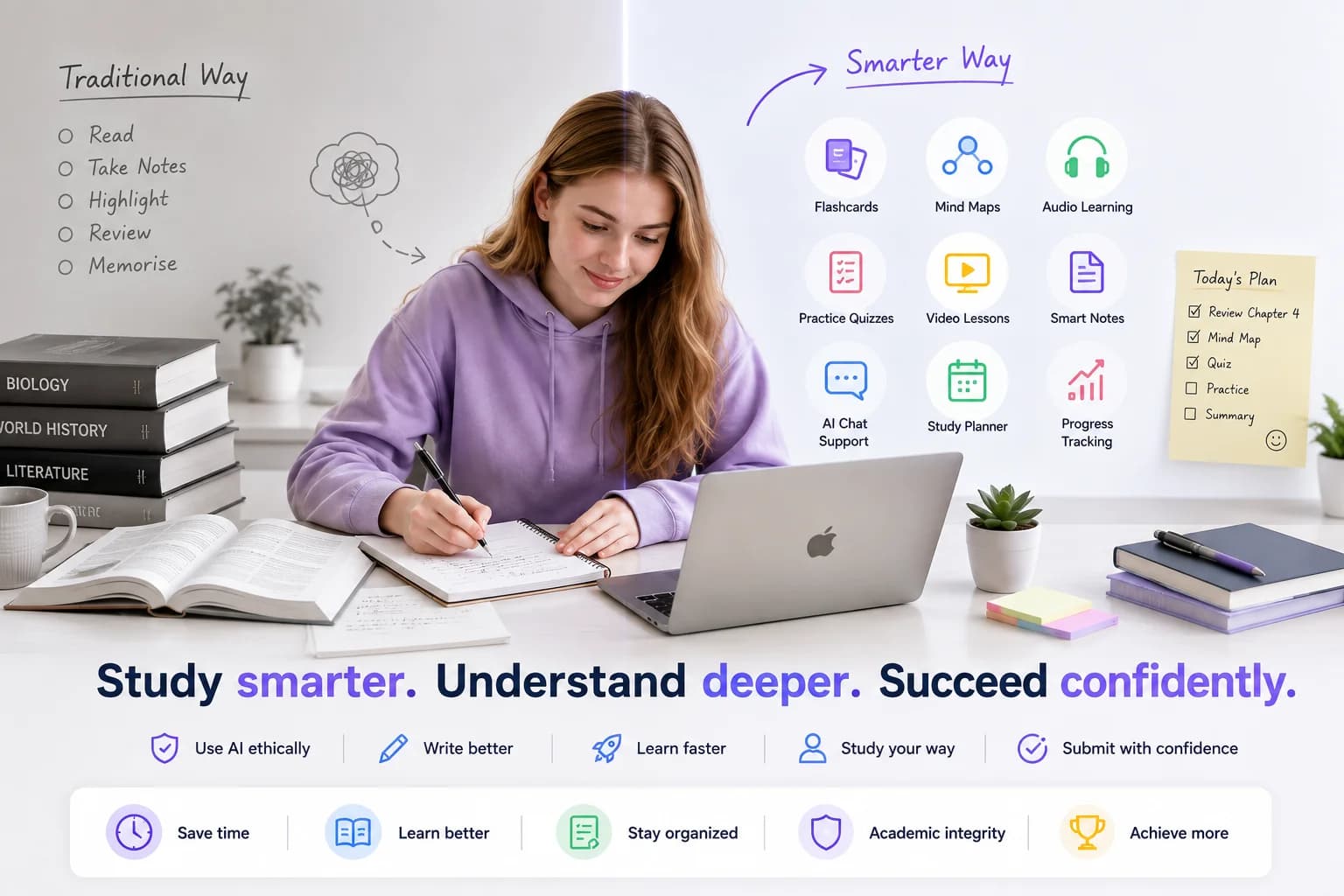
AI for students should do more than produce quick answers. Used well, it can help students understand difficult lessons, remember important information, organise their ideas and explain what they have learned.
The difference lies in how the student uses the tool.
One student may ask AI to complete a homework task and submit the generated answer with only a few changes. The result may look polished, but the student may struggle to explain it during a class discussion.
Another student can use AI to turn the same lesson into flashcards, organise it as a mind map, listen to an audio explanation and complete a practice quiz. After reviewing the material, that student writes the final answer independently.
Both students used AI. However, only one used it as a learning partner.
This guide explains nine positive uses of AI for students. It also explores multilingual audio learning for international students, responsible AI writing support, future education trends and the boundaries every learner should follow.
Free Readability and Tone Diagnostic
Check if your draft sounds natural and clear. Paste a paragraph below to simulate readability scoring and tone analysis.
TL;DR
- AI can turn notes, chapters and permitted PDFs into flashcards, mind maps, quizzes, notes and audio lessons.
- Students learn more when AI asks them to retrieve, explain and apply information instead of simply giving them an answer.
- International students can use multilingual audio as a bridge between understanding a topic and expressing it in academic English.
- AI writing support should improve a student’s real ideas rather than inventing arguments on the student’s behalf.
- Students must check facts, verify citations, protect private information and follow the rules for each assignment.
- The best AI study session ends with the student explaining the topic without AI.
The student dilemma in 2026
Students now have access to tools that can summarise chapters, solve problems, generate essays and create study materials within seconds.
That convenience creates a difficult question:
Are you learning more efficiently, or are you quietly removing yourself from the learning process?
Avoiding AI completely may mean missing useful support. However, relying on it for every difficult step can weaken independent thinking and subject knowledge.
The better approach sits between those two extremes.
| Approach | What happens | Likely result |
| Outsource the task to AI | AI reads, decides and writes for the student | Fast completion but limited understanding |
| Use AI as a learning partner | AI reorganises, questions, explains and gives feedback | Active practice and stronger understanding |
The Organisation for Economic Co-operation and Development, usually called the OECD, makes a similar distinction in its 2026 Digital Education Outlook. The report explains that generative AI may improve task performance without necessarily producing meaningful learning. Educational value depends on how the tool is designed and how actively the student uses it.
The goal is not to use AI for every possible task. It is to use AI where it improves the learning process without removing the student from that process.
What does AI for students mean?
AI for students means using artificial intelligence to support the activities that create learning.
Those activities include:
- understanding a new idea;
- retrieving information from memory;
- connecting related concepts;
- applying knowledge to a problem;
- evaluating evidence;
- and communicating an explanation.
AI can help with the organisation and presentation of information. However, students remain responsible for understanding what the information means.
The division of responsibility
| AI can help with | The student remains responsible for |
| Changing the format of information | Understanding and interpreting it |
| Suggesting questions | Answering and checking those questions |
| Organising notes and sources | Choosing reliable evidence |
| Explaining a topic in simpler language | Checking whether the explanation is accurate |
| Reviewing grammar and clarity | Developing the argument |
| Producing practice materials | Proving that learning took place |
| Suggesting a structure | Making the final academic decision |
This distinction is supported by three important international frameworks.
OECD: AI literacy for school students
The OECD publication Empowering Learners for the Age of AI: An AI Literacy Framework for Primary and Secondary Education was released in June 2026. It sets out common learning outcomes for young people and focuses on the knowledge, skills and attitudes they need to understand AI, assess its opportunities and risks, and make informed decisions about its use.
Recommended external link: Link the words OECD AI Literacy Framework to the official OECD publication.
UNESCO: responsible and human-centred AI use
UNESCO’s AI Competency Framework for Students identifies 12 competencies across four areas. These include a human-centred mindset, AI ethics, technical knowledge and responsible participation in the design and use of AI systems.
The framework is relevant because it treats AI use as more than a technical skill. Students also need judgment, ethical awareness and an understanding of AI’s limitations.
Recommended external link: Link the words UNESCO AI Competency Framework for Students to the official UNESCO page.
UNICEF: protecting children in AI systems
Because many high school students are minors, UNICEF’s guidance is also important.
UNICEF’s updated Guidance on AI and Children sets out requirements for child-centred AI. These include safety, privacy, fairness, transparency, inclusion, accountability and respect for children’s rights.
Recommended external link: Link the words UNICEF Guidance on AI and Children to the official UNICEF page.
Together, these frameworks support one clear principle:
AI should increase a student’s ability to understand and decide. It should not quietly take control of those decisions.
Nine positive uses of AI for students
The following table provides a quick overview.
| AI study method | Best used for | Main advantage | Main risk |
| Flashcards | Facts, terms and processes | Active recall | Incorrect or weak cards |
| Mind maps | Complex and connected topics | Shows relationships | Oversimplification |
| Audio learning | Portable revision | Flexible review | Passive listening |
| Practice quizzes | Test preparation | Immediate feedback | Poor-quality questions |
| Multiple explanations | Difficult concepts | Different entry points | Loss of nuance |
| Project organisation | Homework and research | Reduces clutter | Invented source details |
| Socratic tutoring | Reasoning and problem-solving | Keeps the student active | Incorrect guidance |
| Writing support | Draft revision | Clearer expression | Loss of ownership |
| Microlearning packs | Large subjects | Manageable study sessions | Fragmented knowledge |
1. Create flashcards from class notes
Flashcards encourage students to retrieve information from memory instead of simply rereading it.
This process is known as active recall. It is useful because recognising an answer on a page is easier than producing that answer without help.
For example:
| Flashcard side | Content |
| Question | What is the role of chlorophyll in photosynthesis? |
| Answer | Chlorophyll absorbs the light energy used during photosynthesis. |
AI tools can create an initial flashcard deck from notes, textbook chapters, study guides or other permitted material.
Conch AI, for example, allows students to turn text from textbooks, notes and research material into editable flashcards. Students can review, modify, delete and export the generated cards.
Why AI flashcards help
- Faster preparation: Students do not need to type every card manually.
- Active revision: Each card requires a response rather than passive reading.
- Clearer knowledge gaps: Students can quickly see which topics they cannot explain.
- Focused practice: Difficult cards can receive more attention than familiar ones.
- Editable study material: Students can correct, shorten or expand the generated cards.
A better flashcard workflow
Add permitted notes or textbook material
↓
Generate definition, comparison and application cards
↓
Check every answer against the original source
↓
Remove repeated or unhelpful cards
↓
Answer without looking
↓
Review the cards you missed
High school example
A student preparing for a biology exam could create separate card groups for:
- scientific definitions;
- labelled cell structures;
- biological processes;
- differences between related terms;
- and exam-style applications.
The AI-generated deck should remain a first draft. Weak questions, vague answers and incorrect details can waste study time rather than save it.
Watch out for
Flashcards can encourage memorisation without understanding. Include questions that ask why, how and what would happen if, not only questions that ask for definitions.
2. Build mind maps for complex topics
A mind map turns a long topic into a visible structure.
It begins with one central concept. Branches then show related causes, effects, examples, evidence, arguments and questions.
For example:
┌─ New inventions
├─ Factory production
Industrial Revolution ──┼─ Urban growth
├─ Working conditions
└─ Social change
Conch AI can turn pasted text from chapters, articles, lecture notes and research papers into interactive mind maps. Students can rearrange the nodes, explore the connections and convert the map into flashcards.
Why AI mind maps help
- They reveal connections: Relationships hidden inside long paragraphs become easier to see.
- They reduce overload: Students can understand the overall structure before studying each detail.
- They support writing: Strong branches can become essay sections or presentation slides.
- They expose missing ideas: A map may show that a student has listed causes but forgotten consequences.
- They support revision: A large chapter can be reviewed as one connected visual.
How to prompt a stronger mind map
Ask the AI tool to separate:
- central ideas;
- supporting evidence;
- causes and effects;
- dates and events;
- examples;
- opposing views;
- and unanswered questions.
Mind-map workflow
Read the source
→ Generate the first map
→ Check the branches
→ Add missing connections
→ Remove weak details
→ Redraw the map from memory
The final stage matters. The first map reflects how the AI organised the topic. The revised map should reflect how the student understands it.
Best used for
Mind maps work especially well for:
- history timelines;
- literature themes;
- biology systems;
- geography case studies;
- cause-and-effect topics;
- and essay planning.
Watch out for
A neat diagram can make a topic appear simpler than it is. Important exceptions, disagreements and uncertainty should remain visible.
3. Turn chapters and PDFs into audio lessons
Audio learning gives students another way to review information.
AI tools can convert notes, articles, presentations, chapters and permitted PDFs into spoken explanations or podcast-style discussions. Students can then listen while commuting, walking, doing light exercise or completing routine tasks.
Conch AI’s Podcast Generator can turn PDF, DOCX, PPTX and TXT files into multi-host podcasts. The current product page says students can use the feature to turn lecture notes and textbooks into audio for listening during commutes, exercise or chores. It currently supports multiple podcast modes, natural voices, transcripts and several languages.
Why AI audio learning helps
- Portable revision: Students can review lessons away from a desk.
- Repeated exposure: A difficult explanation can be replayed.
- Alternative presentation: A spoken conversation may make the main argument easier to follow.
- Reading preparation: Students can hear a short overview before beginning a difficult chapter.
- Language support: Some students can first review a concept in a more familiar language.
A responsible audio workflow
┌──────────────────────────────┐
│ Add permitted study material │
└──────────────┬───────────────┘
↓
┌──────────────────────────────┐
│ Generate an audio overview │
└──────────────┬───────────────┘
↓
┌──────────────────────────────┐
│ Listen and record questions │
└──────────────┬───────────────┘
↓
┌──────────────────────────────┐
│ Return to the original text │
└──────────────┬───────────────┘
↓
┌──────────────────────────────┐
│ Explain the topic yourself │
└──────────────────────────────┘
Audio learning should support reading rather than replace it. An audio summary may overlook a table, weaken an important qualification or simplify part of an argument.
Why multilingual audio matters for international students
International students often manage two demanding tasks at once:
- understanding an unfamiliar or difficult subject;
- processing and expressing that subject in a second or third language.
A student may understand history, science or economics more confidently in a language used at home or during earlier schooling.
This does not mean that every learner has one fixed “best language.” Comprehension depends on several factors, including fluency, previous education, subject vocabulary and the difficulty of the material.
However, a familiar language can provide a useful starting point for some students.
The multilingual learning bridge
| Stage | Student action | AI support |
| Understand | Review the concept in a familiar language | Generate an audio explanation |
| Compare | Return to the original English source | Identify important English terms |
| Explain | Restate the idea without reading | Organise the explanation |
| Express | Draft the idea in English | Review clarity and grammar |
| Verify | Compare the draft with the source | Flag possible inconsistencies |
A practical multilingual audio workflow
- Add permitted notes, a chapter, presentation or research paper.
- Ask AI to identify the main ideas and technical vocabulary.
- Generate an audio explanation in a familiar language where that language is supported.
- Listen while walking, travelling or exercising.
- Return to the original English material.
- Mark the points that remain unclear.
- Explain the topic aloud in the familiar language.
- Explain it again using the main English terms.
- Write a short English summary.
- Use AI to review the clarity of that summary without changing its meaning.
- Compare the final version with the original source.
This method separates understanding the subject from expressing the subject.
The student first develops a clear idea. The next task is to communicate that idea in academic English.
A language barrier should not automatically be treated as a knowledge gap.
The explain-it-back rule
Listening can feel productive even when little information has been retained.
After an audio lesson, students should explain the idea again by:
- recording a voice note;
- teaching it to a classmate;
- writing five key points;
- drawing a diagram;
- or answering an exam question.
AI can then help organise the student’s explanation. However, it should not add arguments the student cannot understand or defend.
The quality of the final writing should reflect the quality of the student’s real understanding.
Related Reading
- How to Calculate H Index
- How to Write an Informative Essay
- Technology Essay
- How to Write a Header for an Essay
- How to Write a Biography Essay
- How to Write a Reflection Paper
- How to Write an Encyclopedia Entry
- Speech Analysis Example
- What is a Good H Index
- How to improve Academic Writing
- How to use Ai for Essay and Research Papers Ethically
4. Generate practice quizzes
AI can create practice questions from a lesson, revision guide or selected set of notes.
The questions may include:
- multiple choice;
- true or false;
- short answers;
- calculations;
- source analysis;
- and extended responses.
Why AI quizzes help
- Immediate practice: Students do not need to wait for another teacher-made test.
- Adjustable difficulty: Questions can progress from basic facts to applied reasoning.
- Fast feedback: The tool can explain what was missing from an answer.
- Exam preparation: Students can practise with a timer or mark scheme.
- Repeated attempts: New questions can be generated for weak areas.
Passive quiz versus active quiz
| Passive approach | Active approach |
| Generate the questions and answers together | Hide the answers |
| Read through the list | Answer one question at a time |
| Check whether the answer looks familiar | Explain why the answer is correct |
| Move on quickly | Review mistakes and retry |
Useful quiz prompt
Test me on this lesson one question at a time. Do not show the answer until I respond. After each response, explain what I understood, what I missed and where I can check the correct information.
Student-friendly AI platforms are moving beyond one-time answer generation.
Conch AI provides connected study tools for notes, flashcards, mind maps, podcasts and document-based chat. Its Notes feature can also convert organised notes directly into flashcards or mind maps.
Google’s NotebookLM provides another example of this category. It can generate source-based flashcards and quizzes, while other NotebookLM features include Mind Maps and Audio Overviews. Gemini also offers a Guided Learning mode intended to support step-by-step learning rather than only producing a final answer.
Together, these tools show how educational AI is moving toward interactive practice, source-based learning and multiple study formats.
Watch out for
AI may create questions that are too easy, unrelated to the curriculum or based on an incorrect interpretation. Students should compare each quiz with their teacher’s learning objectives.
5. Ask for several explanations
Students sometimes reread the same textbook paragraph several times without understanding it.
Instead of repeating the same explanation, AI can present the idea in another form.
A student might ask:
- Explain this in plain language.
- Give me a real-life example.
- Compare this with a related concept.
- Explain it as a sequence of steps.
- Use an analogy.
- Show me a common mistake.
- Ask me a question to test my understanding.
Why multiple explanations help
| Benefit | How it supports learning |
| Different entry points | One explanation may connect with what the student already knows |
| Stronger recognition | The student sees the same concept in different forms |
| Clearer vocabulary | Difficult terms can be explained without being removed |
| Better questions | The student can identify the exact point of confusion |
| Improved confidence | The learner has more than one way to approach the topic |
Example
A physics student struggling with electrical resistance could request:
- a one-sentence definition;
- a water-pipe analogy;
- a worked calculation;
- a diagram description;
- and one exam-style question.
Together, these explanations provide a broader understanding than a single simplified answer.
Watch out for
Simple explanations can remove important detail. Ask the AI:
Which parts did you simplify, and what important detail should I still understand?
6. Organise homework, research and school projects
Large assignments often involve several kinds of information.
A student may have teacher instructions, class notes, website sources, quotations, images, deadlines and presentation requirements. AI can help turn these separate items into a clear plan.
Why AI organisation helps
- Less clutter: Information can be grouped by topic or purpose.
- Smaller steps: A large project becomes a sequence of manageable tasks.
- Source comparison: Students can compare evidence and viewpoints.
- Better timing: Research, drafting and revision can receive separate deadlines.
- Clearer priorities: Students can identify which tasks must be completed first.
Project-planning table
| Project stage | Student responsibility | Possible AI support |
| Understand the task | Interpret the teacher’s instructions | Turn instructions into a checklist |
| Research | Select credible sources | Group sources by topic |
| Plan | Decide the main argument | Suggest an outline structure |
| Create | Write or design the work | Review clarity and organisation |
| Verify | Check facts and citations | Flag missing information |
| Submit | Make the final decision | Produce a final checklist |
Conch AI currently includes a Study Planner designed to build study schedules around subjects, availability and learning goals. It also offers structured note generation from source material.
High school example
For a geography presentation, a student could follow this workflow:
Confirm the question
→ Collect three credible sources
→ Record the key evidence
→ Build a slide outline
→ Create visuals
→ Practise the explanation
→ Check citations
AI may help organise the process, but the student must still select and open every source.
Watch out for
AI can invent source details, misstate an author’s conclusion or produce a quotation that does not exist. Never use a citation without checking the original publication.
7. Use AI as a Socratic tutor
A weak AI tutor gives the final answer immediately.
A stronger tutor asks questions, provides hints and encourages the student to explain each step. This approach is often called Socratic tutoring because the learner is guided through questions rather than handed a conclusion.
Answer machine versus learning partner
| Answer machine | Socratic learning partner |
| Gives the final answer | Asks a guiding question |
| Removes uncertainty | Helps the student investigate it |
| Rewards copying | Requires explanation |
| Completes the task | Supports the reasoning process |
| Hides knowledge gaps | Makes knowledge gaps visible |
Socratic tutor prompt
Act as a tutor for this topic. Ask me one question at a time. Do not give me the final answer immediately. Give me one hint if I get stuck, and ask me to explain my reasoning before moving forward.
Why a Socratic AI tutor helps
- Private practice: Students can ask questions without feeling embarrassed.
- Immediate support: Practice can continue outside school hours.
- Adjusted difficulty: The next question can become easier or harder.
- Visible reasoning: Students must explain how they reached an answer.
- Greater independence: The student practises solving rather than copying.
Conch AI’s document-based Chat feature allows students to upload supported documents, ask questions and create connected study materials from their own sources.
The wider direction of education policy supports this active model. The OECD’s 2026 AI literacy framework emphasises informed judgment and meaningful participation rather than passive tool use.
Watch out for
An AI tutor can still make mistakes. Important explanations should be checked against textbooks, teacher materials or trusted sources.
8. Improve academic writing without losing your voice
AI writing support can help students review:
- grammar;
- unclear wording;
- sentence length;
- paragraph order;
- transitions;
- repetition;
- and tone.
This can be especially useful when a student understands the subject but struggles to express that understanding clearly in English.
The expression gap
An international student may have a strong argument but write sentences that sound unclear, awkward or translated.
In this situation, AI can help improve the expression without replacing the idea.
| Student provides | AI may support |
| The argument | Clearer sentence structure |
| The evidence | More logical paragraph order |
| The example | Improved transitions |
| The interpretation | Grammar and word-choice feedback |
| The final judgment | Concision and readability |
Responsible writing workflow
Develop your own idea
→ Collect evidence
→ Write a rough draft
→ Ask AI to identify unclear areas
→ Review each suggestion
→ Rewrite in your own voice
→ Verify the final meaning
What humanised AI writing should mean
Humanised AI writing should not mean disguising an assignment that a student did not create.
It should mean revising AI-assisted language so it reflects:
- the student’s actual idea;
- the student’s evidence;
- the student’s examples;
- the correct level of certainty;
- and the student’s natural voice.
Conch AI’s Rewrite Mode is designed to review areas such as clarity, tone, readability, flow, grammar and structure. Students should still inspect every suggested change and confirm that the revised text preserves their intended meaning.
Instead of asking only, “Will this pass an AI detector?” students should ask:
- Is the information accurate?
- Does this represent my real thinking?
- Can I explain the evidence?
- Have I followed the assignment rules?
- Does this sound like something I genuinely mean?
Watch out for
Improving the expression of your own ideas is different from using a humanisation tool to hide work that you did not create or understand.
9. Build personal microlearning packs
Large chapters can feel difficult because students do not know where to begin.
AI can divide a topic into smaller study packs. Each pack can focus on one clear learning outcome.
Example microlearning pack
| Component | Suggested content |
| Overview | A two-minute introduction |
| Recall | Five flashcards |
| Practice | Three questions |
| Visual | One diagram or mind map |
| Application | One real-life example |
| Reflection | One explain-it-back question |
Why microlearning packs help
- Lower starting resistance: Students face one manageable topic.
- Clear study goals: Each session has a defined outcome.
- Regular revision: One pack can be completed each day.
- Visible progress: Finished sections show what has been covered.
- Flexible formats: Each pack can combine text, visual, audio and practice activities.
Watch out for
Breaking a subject into small parts can hide the relationships between those parts. Students should finish each pack by asking:
How does this topic connect with the rest of the chapter?
The 20-minute AI study loop
The following workflow combines the strongest uses of AI without allowing the tool to control the entire study session.
| Time | Stage | What to do |
| 1–3 minutes | Set the goal | Write one clear learning outcome |
| 4–8 minutes | Study the source | Read the relevant class material |
| 9–12 minutes | Change the format | Create one map, quiz, audio explanation or card set |
| 13–16 minutes | Test yourself | Answer without looking at the source |
| 17–19 minutes | Check the gaps | Correct mistakes using the original material |
| 20 minutes | Prove the learning | Explain the topic without AI |
Example learning goal
By the end of this session, I will be able to explain three causes of the First World War and show how they are connected.
The final stage is the most important. The student must produce an explanation without depending on the tool.
What is the near future of AI for students?
Student-focused AI tools are already moving beyond simple question-and-answer chat.
Conch AI can currently connect several stages of the study process. Students can work with structured notes, editable flashcards, visual mind maps, document-based chat, podcasts and study planning inside one wider learning workflow.
Other platforms show the same category shift. Google’s NotebookLM can generate source-based flashcards and quizzes, and it also provides Mind Maps and Audio Overviews.
These products are early examples of a broader change. Educational AI is moving from one-time answer generation toward systems that reorganise course material, adapt practice, support several formats and help students demonstrate what they have learned.
Five developments are likely to shape the next stage.
1. More source-based AI tutors
Future tools will increasingly work from approved textbooks, course notes and teacher materials.
This approach can make answers easier to check because students can compare the explanation with a defined source. However, source-based tools can still misunderstand or oversimplify the content.
2. More multilingual learning
Students will increasingly move between languages without losing the original subject vocabulary.
A likely workflow will be:
Understand in a familiar language
→ Review the original terminology
→ Discuss the idea
→ Write in academic English
→ Verify the final meaning
This could be especially valuable for students who understand a subject well but need additional support expressing it in the language of instruction.
3. More personalised practice
AI systems will identify patterns in a student’s mistakes and adjust future questions.
A learner who struggles with one type of algebra problem may receive more practice in that area. A student who has mastered definitions may move toward application, comparison and analysis.
The value of personalisation will depend on whether the system promotes independent thinking or simply keeps the student inside an automated sequence.
4. Greater focus on AI literacy
Students will increasingly need to understand:
- how AI systems produce answers;
- why an answer may be wrong;
- how to protect personal data;
- how to check sources;
- when to disclose AI assistance;
- and when not to use AI.
The OECD’s 2026 framework confirms that AI literacy is becoming a formal priority for primary and secondary learners.
UNESCO’s framework adds that students need ethical judgment and a human-centred understanding of AI, not only the ability to operate a tool.
5. More evidence of the learning process
Teachers may ask students to submit more than a polished final answer.
They may also review:
- planning notes;
- source records;
- first drafts;
- revision histories;
- oral explanations;
- and statements describing how AI was used.
This approach can help teachers see how the student developed the final work and whether the student understands it.
Seven boundaries every student should follow
| Boundary | What can go wrong | Better approach |
| Do not submit work you cannot explain | The student cannot defend the answer | Use AI for hints and feedback |
| Check important facts | Confident but false information enters the work | Compare claims with trusted sources |
| Verify citations | Invented sources enter the assignment | Open and read every source |
| Protect private data | Personal or school information is exposed | Remove sensitive content |
| Follow assignment rules | Acceptable use differs by teacher | Check each task separately |
| Do not hide ghostwriting | AI-generated work is presented as original | Revise only from genuine understanding |
| Allow productive struggle | The tool removes every difficult step | Try first, then request guidance |
UNICEF’s child-centred AI guidance reinforces the importance of safety, privacy, fairness, transparency and accountability for systems used by children and young people.
Use the THINK framework
Before relying on an AI output, students can run a five-part check.
| Letter | Check | Question |
| T | Task rules | Is AI allowed for this task? |
| H | Human ownership | Which ideas and decisions came from me? |
| I | Information check | Did I verify the facts and sources? |
| N | No private data | Did I remove sensitive information? |
| K | Knowledge gained | Can I explain the topic without AI? |
If the answer to the final question is no, the tool probably improved the output more than it improved the learning.
How Conch AI can support the learning workflow
Conch AI is positioned as more than a writing tool. Its current product suite connects several activities involved in studying, understanding and expressing knowledge.
A responsible Conch workflow can look like this:
Permitted study material
↓
Structured notes
↓
Flashcards, mind maps or podcasts
↓
Student review and self-testing
↓
Student explanation
↓
Student-written draft
↓
Clarity and language review
↓
Source verification
↓
Final student decision
The workflow in detail
- Add permitted notes, chapters, PDFs, presentations or early ideas.
- Use Conch AI to organise the material into structured notes.
- Convert the notes into flashcards or a mind map where useful.
- Create an audio podcast when listening will support revision.
- Ask questions about the source material through document-based chat.
- Test your understanding without looking at the answers.
- Explain the subject in your own words.
- Create your own outline and first draft.
- Use writing support to improve clarity, flow and academic expression.
- Check every fact, citation and change.
- Make the final decision and submission yourself.
This workflow reflects Conch AI’s broader direction as an academic learning partner: helping students change the format of information, understand it more clearly and communicate what they have genuinely learned.
Responsible AI checklist for students
Before completing an AI-supported task, confirm that:
- I had permission to upload the material.
- I checked the output against the original source.
- I answered questions before viewing the solutions.
- I corrected weak flashcards or mind maps.
- I explained the topic in my own words.
- I verified the important facts.
- I opened and checked every citation.
- I protected private information.
- I followed my teacher’s rules.
- I can defend the final work.
Frequently asked questions about AI for students
What is the best use of AI for students?
The best uses keep students active. Flashcards, guided quizzes, mind maps, audio review, Socratic tutoring and feedback on a student’s own writing can all support learning when the student checks the output and explains the topic independently.
Is using AI for school cheating?
Not automatically. The answer depends on the assignment and the school’s policy. AI may be permitted for revision, brainstorming or language feedback even when it is not permitted to generate the submitted answer.
Can AI create flashcards from a PDF?
Some AI tools can generate flashcards from PDFs, notes and other study material. Conch AI currently generates editable flashcards from pasted study content, while its wider document workflow supports formats including PDF, DOCX and PPTX in relevant tools. Students should check every card against the source.
Can AI turn a chapter or PDF into a podcast?
Yes. Conch AI’s Podcast Generator currently accepts PDF, DOCX, PPTX and TXT files and turns them into spoken podcast-style content. Students should upload only material they have permission to use and should verify the audio against the original source.
How can international students use AI?
International students can use AI to review difficult material in a familiar language where that language is supported. They can then return to the original terminology, explain the idea independently and work on expressing it in academic English.
Can AI help high school students write better?
AI can identify grammar problems, unclear sentences, repetition and weak organisation. However, the argument, evidence, examples and final judgment should come from the student.
What is humanised AI writing?
Humanised AI writing reflects a student’s genuine meaning, reasoning and voice. It should not be used to disguise work that the student did not create or understand.
Is AI always accurate?
No. AI can produce factual, mathematical, logical and citation errors. Important information should be checked against class materials, original sources and trusted publications.
Which AI frameworks should students know about?
Three useful frameworks are:
- the OECD AI Literacy Framework for Primary and Secondary Education;
- the UNESCO AI Competency Framework for Students;
- and UNICEF’s Guidance on AI and Children.
Together, they cover AI literacy, ethical use, human responsibility, privacy, safety and children’s rights.
Conclusion: use AI to create more learning
AI for students can make education more flexible, personal and accessible.
One chapter can become a flashcard deck, a mind map, a quiz and an audio explanation. International students can also use multilingual audio as a bridge between understanding a concept and expressing that concept in academic English.
However, the student must remain active throughout the process.
A successful AI study session should produce:
- clearer questions;
- stronger understanding;
- better practice;
- more confident explanations;
- and work the student can defend.
Let AI change the format, organise the material and provide feedback.
Keep the thinking, judgment and final decisions yours.
Call to action
Use Conch AI to turn permitted study material into organised notes, flashcards, mind maps and podcasts. Test your understanding, develop your own ideas and improve the clarity of your academic writing without giving away ownership of the learning process.
Learn in the format that works for you. Then express what you learned in your own voice.
Related Reading
- Ai Annotated Bibliography
- Leadership Essay Examples
- Social Media Argumentative Essay Topics
- Topic Sentence vs Thesis Statement
- Evaluation Essay Examples
- National Honor Society Essay Examples
- Proposal Essay Examples
- Diversity Essay Examples
- Literary Analysis Essay Examples
- Informative Essay Topics
- Positive Use Cases of Humanised Writing
- How to improve Academic English
- How to use Ai for Essay & Research papers Ethically

About the Author: PragyaVerified Editor
Academic Policy Specialist & AI Ethics Researcher
Pragya is a learning specialist and content editor focusing on student productivity, academic integrity, and responsible AI integration. They hold extensive experience guiding students through research standards, citation guidelines, and text refinement workflows.