
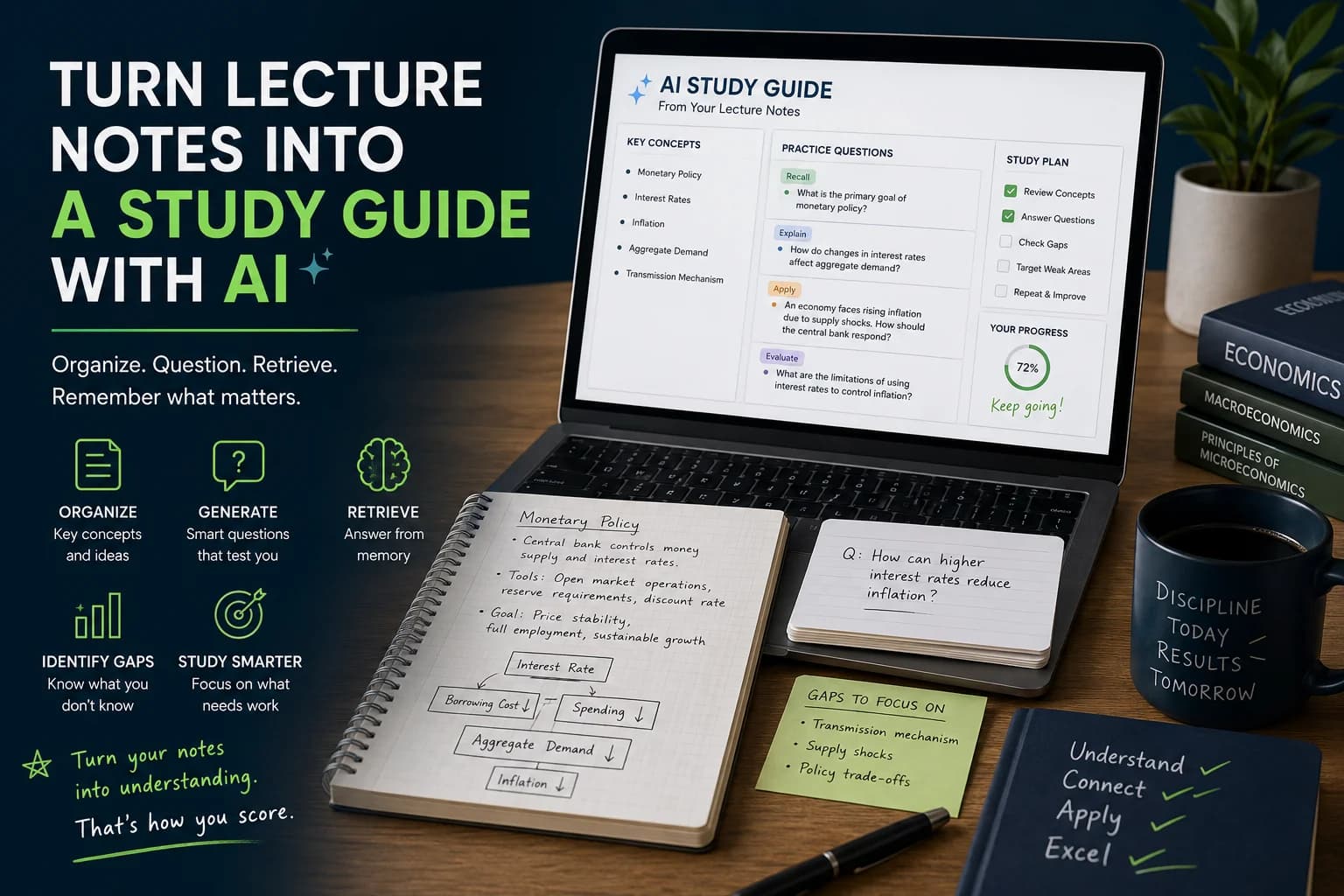
How to Turn Lecture Notes Into a Study Guide With AI: The Complete Masterclass

Pragya
⚡TL;DR Key Takeaways
- Turn lecture notes into an AI study guide that actually helps you learn.
- method to organize notes, create questions, make flashcards, practice active recall, and find what you need to review.
- You can sit in a lecture hall for fifteen weeks, generate forty pages of meticulously highlighted notes, build color-coded binder tabs, and still walk into a mid-term or final exam feeling as though you signed up for the wrong course.
Table of contents44 sections
You can sit in a lecture hall for fifteen weeks, generate forty pages of meticulously highlighted notes, build color-coded binder tabs, and still walk into a mid-term or final exam feeling as though you signed up for the wrong course.
This experience is overwhelmingly common across university campuses and professional certification programs alike. The problem is almost never a complete lack of information. In modern academic environments, students rarely suffer from an information deficit. Usually, they suffer from information overload.
On any given topic, you likely possess:
- Slide decks from lecture sessions
- Raw, quickly typed class notes
- Highlighted PDF textbook chapters
- Screenshots of chalkboard diagrams you no longer remember taking
- Unstructured audio recordings or AI transcripts
- Scattered assignments, problem sets, and lab reports
- A single, cryptic phrase handwritten in red ink in the margin: VERY IMPORTANT — EXAM.
Past You apparently possessed strong faith in Future You. Future You, however, is now staring at a wall of unstructured text three days before the exam, attempting to decipher what “Important” actually meant.
The core challenge of studying is not acquiring more content; it is converting raw information into a structured mental model that your brain can retrieve, connect, explain, and apply under pressure. This is where an artificial intelligence study assistant can become a game-changing asset—provided you assign it the correct job.
If you ask an AI model to summarize your lecture notes, it will give you shorter notes. You will have reduced forty pages to four pages, but you will still be engaging in passive reading. If, however, you direct AI to re-architect your material around fundamental concepts, synthesize hidden relationships, generate targeted self-assessment questions, and facilitate active recall, you build something vastly superior: a personalized system for deep learning.
Free Readability and Tone Diagnostic
Check if your draft sounds natural and clear. Paste a paragraph below to simulate readability scoring and tone analysis.
TL;DR
An AI study guide is useful only if it helps you think better, not just read less.
The strongest workflow is to turn lecture notes into a system that helps you identify core concepts, connect ideas, test understanding, and find weak areas before an exam or assignment.
Use AI to organize the material, create better questions, build flashcards or mind maps where they make sense, and reduce repetitive work. Then close the notes and try to retrieve the ideas yourself.
A good study guide should help you move from:
notes → concepts → questions → retrieval → mistakes → targeted review
The real value is not a cleaner summary. It is knowing what you understand, what you do not, and what to study next.
How to turn lecture notes into a study guide with AI –
1. Notes vs. Summaries vs. Study Guides
Before invoking AI to transform your coursework, you must clearly distinguish between the three primary documents produced during an academic term. Confusing these three distinct assets is the single most common reason students spend dozens of hours studying yet fail to achieve mastery.
| Attribute | Lecture Notes | Summary | Study Guide |
| Primary Goal | Capture information in real time | Reduce information volume | Prepare knowledge for functional application |
| Cognitive Action | Listening, transcribing, speed-writing | Reading, condensing, highlighting | Retrieving, explaining, connecting, applying |
| Structure | Chronological (organized by date/lecture) | Condensed (organized by chapter/section) | Hierarchical & Functional (organized by concept & question) |
| Orientation | Input-focused (What was said?) | Content-focused (What does it say briefly?) | Performance-focused (Can I execute tasks with this?) |
Lecture notes tell you what was covered during class. A summary tells you what the material says in fewer words. A true study guide poses a direct challenge: Can you do anything meaningful with what you learned when the answers are removed?
The Fatal Flaw: Summary-First Studying
The traditional approach to studying using AI typically follows a passive, low-retention loop:
Raw Notes⟶AI Summary⟶Reread Summary⟶Reread Again⟶Exam
This workflow feels productive because it keeps you surrounded by course material. Your eyes pass over familiar terms, triggering cognitive recognition. You tell yourself, “Yes, I know what demand-pull inflation is,” or “Yes, I remember reading about classical conditioning.”
However, recognition is not retrieval. Recognition means you can identify an answer when it is placed directly in front of you. Retrieval means you can extract the concept from memory, structure it logically, and apply it to a fresh context on a blank exam sheet.
Contrast the passive loop with a Learning-First AI Workflow:
Raw Notes⟶Core Concepts⟶Generative Questions⟶Active Retrieval⟶Error Analysis⟶Targeted Review
The learning-first workflow forces your brain to work. It provides immediate, objective feedback regarding where your understanding is solid and where it is fragile. That precise feedback loop is where studying ceases to be a passive chore and becomes intelligent preparation.
2. Case Study: Emma’s 47-Page Psychology Dilemma
To ground this framework in reality, consider Emma, a second-year cognitive psychology student preparing for her midterm.
Emma’s digital notebook contains 11 lecture documents, 47 pages of unorganized text, six slide decks, three journal articles, and dozens of screenshots of slide diagrams. Her exam is eight days away.
Her initial impulse is standard: paste all 47 pages into an AI tool and prompt: “Summarize my psychology notes into an easy study sheet.”
The AI model would gladly execute this task. It would return a beautifully formatted, bulleted document. Emma would print it out, highlight it in yellow, read it three times on her couch, and walk into the exam room feeling reasonably prepared.
However, during the exam, she encounters a multi-part free-response question:
“Compare and contrast negative reinforcement with punishment using real-world clinical examples. Explain how spontaneous recovery can complicate behavioral modification plans when extinction protocols are implemented.”
At that moment, Emma’s brain freezes. She recognizes every single word in the prompt. She remembers reading about Pavlov, Skinner, and extinction curves on page two of her AI summary. But because she only reread the summaries instead of synthesizing, comparing, and retrieving the concepts, she cannot structure the answer.
Emma’s real challenge was never that her notes were messy. Her actual needs were diagnostic:
- Which concepts are primary foundations, and which are secondary details?
- How do these theories interact or contradict one another?
- Which ideas can she explain clearly from memory without prompting?
- Which topics does she merely recognize because the notes are sitting open?
- How should she allocate her remaining hours of study time?
Instead of treating AI as a summarization tool, Emma adopts the C.L.E.A.R. Method to construct a study guide that actively trains her brain to think.
3. The C.L.E.A.R. Method Framework
The C.L.E.A.R. framework is a five-stage system designed to convert disorganized lecture artifacts into an active learning engine using AI as a structural assistant.
C.L.E.A.R.
C — Capture the correct course material.
L — Locate the ideas that matter most.
E — Explain those ideas and their connections.
A — Ask questions instead of collecting more answers.
R — Retrieve what you know without looking.
Stage 1: C — Capture the Correct Scope
Before prompting AI to structure your material, ensure your source set is comprehensive. AI can transform content at incredible speed, but it cannot infer crucial professor-led lectures that you forgot to upload.
1. Gather Source Artifacts
Assemble all materials directly relevant to your assessment:
- Class lecture transcripts or personal notes
- Presentation slide decks (PDFs/PowerPoints)
- Required textbook chapters or excerpt readings
- Lab manuals, seminar notes, or tutorial hand-outs
- Past quizzes, problem sets, and sample practice sheets
- Official syllabus learning objectives or revision outlines
2. Preserve Contextual Annotations
Do not strip out your personal margin notes or instructor emphases. Human-added markers contain vital signal value that AI models cannot guess from textbook definitions alone:
- “Instructor spent 20 minutes on this specific proof.”
- “Compare this mechanism with the Week 3 model for the final.”
- “Potential 15-point essay question.”
- “I still do not understand why Step 3 happens here.”
The Two-Minute Material Audit
Before moving forward, complete this pre-flight checklist:
- Have I explicitly identified which exact chapters and lecture dates are in scope?
- Do I have the corresponding slide decks and assigned reading notes for every session?
- Have I included instructor-provided review guides, sample problems, or objectives?
- Do I know the exact format of the assessment (e.g., cumulative, essay, short answer, multiple choice)?
- Have I annotated my raw notes with instructor emphases and persistent personal confusion markers?
Fundamental Rule: A beautifully organized study guide constructed from incomplete course material remains fundamentally incomplete.
Pre-Processing Exercise: The Three-Symbol Tag
Before handing raw text over to AI, scan your personal notes and attach three basic visual symbols to key sections:
★ Important — Central thesis or explicitly emphasized by the professor
? Unclear — ou cannot explain this concept without reading the text
↔ Connected — Links directly to another module or distinct theory
Adding these quick tags converts raw text into a prioritized study roadmap. Stars signal items that require priority question generation, question marks mark topics for deeper AI-guided explanation, and arrows highlight structural relationships.
Stage 2: L — Locate the Conceptual Hierarchy
The goal of stage two is not to shorten your notes—it is to build an intellectual hierarchy.
Academic courses contain multiple tiers of information:
- Level 1: Core Paradigms (The broad theoretical frameworks)
- Level 2: Major Mechanisms (The specific operational components)
- Level 3: Supporting Evidence & Data (Case studies, experiments, historical dates)
- Level 4: Nuance & Exceptions (Boundary conditions, counter-arguments, outliers)
Standard student notes merge all four levels into a uniform block of text. A superior study guide forces these levels into a stark visual hierarchy.
Abandon Calendar-Based Organization
Most student notes are organized chronologically: Week 1, Week 2, Week 3…
Chronological filing is convenient for taking notes, but it actively hinders deep learning. Academic concepts do not respect calendar weeks. A theoretical model introduced in Week 2 will often be evaluated using empirical studies from Week 7, contrasted against a competing paradigm introduced in Week 11, and tested in a final essay question.
When structuring your study guide, ask yourself this foundational question: If the week numbers and dates completely disappeared from my notes, which ideas would naturally cluster together into single conceptual units?
CHRONOLOGICAL FILING (Weak) CONCEPTUAL HIERARCHY (Strong)
┌─────────────────────────┐ ┌─────────────────────────┐
│ Week 1: Intro to Market │ │ Supply & Demand Mechanics│
│ Week 2: Demand Curves │ ────► │ ├── Price Elasticity │
│ Week 3: Elasticity │ │ ├── External Shocks │
│ Week 6: Market Failure │ │ └── Policy Applications │
└─────────────────────────┘ └─────────────────────────┘
The One-Screen Test
Once a topic is compiled, perform the One-Screen Test: Open the document on your screen. Without scrolling, can you immediately discern the intellectual architecture of the unit?
You should be able to instantly pinpoint:
- The primary concept title
- The core operational mechanisms
- Key real-world applications or quantitative formulas
- Direct comparative relationships with adjacent units
- Marked areas of remaining confusion
If your 40-page lecture folder has turned into a 35-page study document, you have not built a study guide; you have merely created a slightly smaller textbook.
Stage 3: E — Explain Before You Memorize
Stage three is where your study guide transforms from a static document into an interactive testing protocol.
Return to Emma’s psychology coursework. Her notes contain a standard definition:
“Negative reinforcement involves the removal of an aversive stimulus following a target behavior, thereby increasing the future probability that the behavior will recur.”
Emma reads this definition four times. It feels familiar. She tells herself she understands it. However, when she closes her laptop and attempts to explain to a classmate how negative reinforcement differs from positive punishment, she stumbles.
That moment of friction is not a failure of learning, it is the exact moment real learning begins.
Prior to testing herself, Emma experienced the illusion of competence. The definition felt familiar because it was sitting in front of her. The moment the source text was hidden, the gaps in her mental model were exposed.
Vague anxiety (“I’m terrified of psychology”) is useless. Specific, diagnostic confusion (“I can define negative reinforcement, but I cannot construct an original example that distinguishes it from punishment”) is actionable and solvable.
ILLUSION OF COMPETENCE
┌────────────────────────┐
│ Reading Source Material│
│ “This makes sense.” │
└───────────┬────────────┘
│
REMOVE SOURCE
│
▼
DIAGNOSTIC REALITY CHECK
┌────────────────────────┐
│ Self-Explanation Test │
│ “Wait, why does this │
│ mechanism shift?” │
└───────────┬────────────┘
│
▼
TARGETED MASTERY
┌────────────────────────┐
│ Focused Re-Study of │
│ Specific Mechanics │
└────────────────────────┘
The 5-Level Depth Ladder
For every major concept identified in your course, ensure your study guide allows you to climb all five rungs of the Depth Ladder:
LEVEL 5: EVALUATE ── Why does this matter? What are its limits?
LEVEL 4: APPLY ── Can I solve a fresh, unseen scenario with this?
LEVEL 3: CONNECT ── How does this alter or depend on another concept?
LEVEL 2: EXPLAIN ── How does the internal mechanism actually work?
LEVEL 1: DEFINE ── What is the precise, formal definition?
Consider how this applies to a core scientific process like Photosynthesis:
- Define (Level 1): Photosynthesis is the biochemical process by which photoautotrophs convert light energy into chemical energy stored in glucose molecules.
- Explain (Level 2): Photons strike light-harvesting complexes in Chloroplast Thylakoid membranes, exciting electrons that drive an electron transport chain, generating ATP and NADPH to power carbon fixation in the Stroma.
- Connect (Level 3): Cellular respiration uses the glucose and oxygen outputs of photosynthesis as inputs to generate ATP, forming a complementary energy cycle.
- Apply (Level 4): If a plant’s stomata close during a drought, how will the internal ratio of O2 to CO2 alter, and why will this induce photorespiration?
- Evaluate (Level 5): Why is the evolutionary efficiency of Rubisco relatively low compared to other metabolic enzymes, and how do C4 plants overcome this constraint?
A student who stays at Level 1 will struggle with college-level examinations. A student who practices across Levels 1 through 5 will handle complex exam prompts easily.
The Three-Minute Understanding Check
Select any major concept from your course, cover your notes, and complete these five prompts from memory:
- In plain language without jargon, it means…
- The fundamental reason this matters to the broader course is…
- This concept directly interacts with or depends upon…
- A concrete, real-world scenario illustrating this in action is…
- A common trap or misconception students fall into with this topic is…
Wherever your self-explanation breaks down, your precise study target for the next hour is established.
Stage 4: A — Ask Questions Instead of Collecting Answers
This stage represents the core structural shift of the C.L.E.A.R. Method: converting static informational statements into dynamic cognitive prompts.
A traditional study sheet gives you answers:
“Demand-pull inflation occurs when aggregate demand for goods and services in an economy outpaces aggregate supply, bidding up prices.”
A C.L.E.A.R. study guide replaces that passive statement with a four-tier question matrix:
FOUR-TIER QUESTION MATRIX
| RECALL | What is the operational definition of demand-pull inflation? |
| EXPLAIN | What exact macroeconomic mechanisms drive demand to outpace aggregate supply in a rapid expansion? |
| CONNECT | How does central bank interest rate manipulation impact demand-pull inflation versus cost-push inflation? |
| APPLY | If a government increases fiscal spending while supply chains are bottlenecked, which type of inflation emerges? |
By working through four-tier question sets, you force your brain to practice the exact cognitive operations that will be required during an exam.
Scientific Pillars of Active Learning
Educational research from the Institute of Education Sciences and cognitive science labs reinforces four primary learning principles:
- Retrieval Practice: Reconstructing knowledge from memory without looking at reference materials builds stronger neural pathways and improves long-term retention compared to passive reading.
- Spaced Practice: Distributing study sessions over several days leads to better retention than cramming the same number of hours into a single day.
- Concept Mapping: Organizing concepts into visual networks helps students understand how individual ideas fit into the broader system.
- Simulated Test Conditions: Practicing under realistic conditions—with strict time limits and no access to notes—reduces test anxiety and provides an accurate measure of exam readiness.
Stage 5: R — Retrieve Before You Reread
Stage five focuses on execution: forcing active memory retrieval before opening your reference notes.
When working through your generated question sets, assign every response an immediate diagnostic label:
KNOW : Clean, accurate retrieval with zero hesitation or help
│
ALMOST: Understood core logic, but omitted vital terminology
│
NOT YET: Failed to retrieve, drew a blank, or gave wrong answers
Order of Attack for Review
Structure every review session using the Not Yet First priority sequence:
Session Sequence: Not Yet⟶Almost⟶Know
Do not start at page one of your notebook every evening simply because it is first. Page one often contains introductory material you mastered weeks ago. Starting from the beginning wastes valuable energy on content you already know, leaving you exhausted by the time you reach difficult topics.
The “Not Yet” Action Tracker
Maintain a clean, dedicated log of every incorrect retrieval attempt:
| Module / Topic | Error Description | Diagnostic Cause | Next Action Step |
| Negative Reinforcement | Equated it with positive punishment | Focused on the word “negative” as a penalty | Rebuild comparative matrix using 3 concrete scenarios |
| Spontaneous Recovery | Could define it, but forgot temporal factors | Did not link it to the extinction rest interval | Redraw the extinction-rest graph from memory |
| Demand-Pull Inflation | Forgot how fiscal stimulus impacts shifts | Skipped the intermediate aggregate demand equation | Re-derive the AD-AS curve step-by-step |
| APA Citation Standards | Misplaced issue number formatting | Relied on visual memory without practicing | Format 5 raw citations manually without a generator |
4. Format Matching: Matching Knowledge Types to Study Visuals
A frequent mistake when using AI tools is generating hundreds of standardized flashcards for an entire course. Flashcards are useful for paired associations (such as vocabulary or formulas), but they are far less effective for complex, multi-variable systems or long-form essays.
Match your knowledge type to the appropriate structural format:
| Knowledge Type | Best Structural Format | Primary Visual Target |
| Isolated Definitions & Vocabulary | Paired Flashcards | Short Term → Definition |
| Multi-Step Systems & Workflows | Sequential Flowcharts | Decision Nodes & Stage Gates |
| Interconnected Systems & Theories | Mind Maps & Networks | Central Node → Peripheral Branches |
| Comparative Paradigms & Models | Multi-Attribute Tables | Feature × Model Grid |
| Quantitative Laws & Equations | Worked Problem Sets | Step-by-Step Derivations |
| Chronological Developments & History | Sequential Timelines | Time Anchor → Event → Impact |
| Long-Form Arguments & Essays | Structured Outlines | Thesis → Evidence → Counter-Argument |
5. Master AI Prompts & Transformation Workflows
To use AI effectively as a study partner, you need precise prompts. Generic prompts produce vague summaries; structured prompts yield powerful learning tools.
The C.L.E.A.R. Master Study Guide Prompt
Use this prompt to transform messy, unorganized lecture notes into a structured C.L.E.A.R. study guide:
Plaintext
Act as an expert academic tutor in [Insert Subject Name].
Transform the attached raw lecture notes into a structured C.L.E.A.R. Study Guide using ONLY the provided text. Do not hallucinate or introduce external concepts not directly supported by the source text.
Structure the study guide into the following four distinct sections:
1. CONCEPTUAL HIERARCHY:
Group the material by core concepts and theoretical themes, rather than chronological lecture order. Under each main concept, include:
– Core operational definition
– Key mechanisms and components
– Important real-world examples mentioned in the text
– Explicit connections to other course themes
2. COMPARATIVE & PROCESS STRUCTURES:
– Identify any competing theories, models, or processes in the text.
– Convert multi-step processes into clear, numbered sequence steps.
– Present comparative models in a structured text-based comparison matrix comparing core assumptions, key components, and primary limitations.
3. FOUR-TIER QUESTION MATRIX:
For each primary concept, generate four specific questions:
– Recall (Testing basic memory)
– Explain (Testing mechanistic understanding)
– Connect (Testing structural relationships)
– Apply (Testing scenario-based problem solving)
4. DIAGNOSTIC “NEEDS VERIFICATION” LOG:
Flag any statements in the raw notes that are incomplete, ambiguous, contradictory, or missing critical context, labeling them as “Needs Verification.”
The Socratic Oral Examiner Prompt
Use this prompt to turn your AI tool into a dynamic practice partner that tests your retrieval in real time:
Plaintext
Act as an encouraging but rigorous oral examiner for my upcoming test in [Insert Subject Name].
Using ONLY the provided study material, quiz me on one concept at a time.
Follow these rules:
1. Ask me ONE targeted question at a time. Start with a basic Recall question, then move to Explanation, Connection, and Application based on my performance.
2. Wait for my full answer before proceeding.
3. Do NOT reveal the correct answer immediately in your response.
4. After I answer, evaluate my response thoroughly:
– Identify what was accurate.
– Point out key terminology or mechanisms I omitted.
– Assign my answer a rating: [KNOW], [ALMOST], or [NOT YET].
5. Provide a constructive follow-up question or hint if I receive [ALMOST] or [NOT YET], or advance to a higher-level question if I receive [KNOW].
6. Keep a running tally of my score at the bottom of each response.
Start by asking me the very first question now.
6. Worked Example: Deconstructing Raw Psychology Notes
To see the C.L.E.A.R. method in action, let’s look at how raw lecture notes are converted into a structured study guide.
Raw Lecture Notes (Original Input)
classical conditioning / pavlov / UCS -> UCR / bell becomes CS / CR salivation / extinction when CS no UCS / spontaneous recovery?? / generalization vs discrimination IMPORTANT / Watson little albert fear / operant is skinner / positive vs negative reinforcement / punishment reduces behavior / reinforcement increases / negative reinforcement NOT punishment / continuous vs partial ratio vs interval
Transformed C.L.E.A.R. Study Guide (AI Output)
1. Core Conceptual Unit: Behavioral Learning Paradigms
A. Classical Conditioning (Pavlovian Association)
- Core Definition: A passive learning process wherein an organism learns to associate two previously unrelated stimuli, resulting in a reflex response to a neutral stimulus.
- Mechanistic Components:
- Unconditioned Stimulus (UCS): An environmental trigger that naturally and automatically evokes a response without prior learning (e.g., meat powder).
- Unconditioned Response (UCR): The unlearned, naturally occurring physiological reflex to the UCS (e.g., salivation).
- Conditioned Stimulus (CS): A previously neutral stimulus that, after paired association with the UCS, triggers a learned response (e.g., bell tone).
- Conditioned Response (CR): The learned physiological response to the CS alone (e.g., salivation to bell tone).
B. Classical Conditioning Processes
- Acquisition: The initial stage of learning where the neutral stimulus is repeatedly paired with the UCS until the association is established.
- Extinction: The gradual weakening and ultimate suppression of the CR when the CS is repeatedly presented without the UCS.
- Spontaneous Recovery: The sudden reappearance of a suppressed CR following a rest period after extinction, demonstrating that the learned association is inhibited rather than erased.
- Generalization: The tendency for stimuli similar to the CS to evoke similar conditioned responses (e.g., Little Albert fearing all white fluffy objects).
- Discrimination: The learned ability to distinguish between a CS and other irrelevant stimuli, responding only to the specific CS.
2. Critical Comparison Matrix: Reinforcement vs. Punishment
| Behavioral Dimension | Reinforcement (Increases Target Behavior) | Punishment (Decreases Target Behavior) |
| Positive (Adding a stimulus) | Positive Reinforcement: Presenting a favorable stimulus following a target behavior (e.g., giving a reward for completing homework). | Positive Punishment: Administering an unpleasant stimulus following a target behavior (e.g., issuing a reprimand for turning in work late). |
| Negative (Removing a stimulus) | Negative Reinforcement: Removing an unpleasant stimulus following a target behavior (e.g., turning off an annoying alarm when you stand up). | Negative Punishment: Withdrawing a favorable stimulus following a target behavior (e.g., revoking car privileges after breaking curfew). |
Critical Trap Alert: Negative reinforcement is frequently confused with punishment. Remember: Reinforcement always increases a behavior; punishment always decreases it. Negative always means removing a stimulus; positive always means adding one.
3. Four-Tier Question Set
- Recall Question: What distinguishes an unconditioned stimulus from a conditioned stimulus in Pavlovian experiments?
- Explanation Question: How does spontaneous recovery demonstrate that extinction is an inhibitory process rather than complete unlearning?
- Connection Question: How do classical conditioning (associations) and operant conditioning (consequences) work together in phobia acquisition and maintenance?
- Application Question: A child feels anxious whenever they hear a specific notification chime on their phone after receiving bad news accompanied by that chime. Identify the UCS, UCR, CS, and CR in this scenario, and recommend a protocol to extinguish the anxiety response.
7. The Post-Lecture 20-Minute Routine
Building a comprehensive study guide should be an ongoing habit throughout the semester, not a marathon session right before finals.
Set aside 20 minutes after each lecture to run this streamlined processing routine:
20-MINUTE POST-LECTURE ROUTINE
| 00-03 min | Clean up raw notes & highlight confusion (?) |
| 03-07 min | Extract the 3-5 primary core concepts |
| 07-10 min | Connect new concepts to previous units |
| 10-14 min | Generate 4-tier active questions with AI |
| 14-18 min | Attempt active recall without looking |
| 18-20 min | Log unresolved gaps in the “Not Yet” tracker |
Investing twenty minutes after each lecture prevents the stress of opening weeks of unorganized notes right before exam week.
8. Common Pitfalls to Avoid
When building study guides with AI, watch out for these frequent mistakes:
| Pitfalls to Avoid | Description |
| Summarization Trap | Turning 40 pages of text into 5 pages of passive text without active self-testing prompts. |
| Over-Flashcarding | Converting complex systems into hundreds of isolated cards, losing the overarching connections. |
| Blind Trust | Assuming AI output is 100% accurate without verifying against primary source materials. |
| Formatting Trap | Spending hours tweaking colors, fonts, and layouts instead of actively retrieving information. |
9. Final Exam Readiness Checklist
Run through this final checklist before your exam to ensure your preparation is complete:
Coverage & Accuracy Verification
- Every topic, chapter, and reading listed on the syllabus is represented in your guide.
- All AI-generated definitions, equations, and steps have been cross-checked against primary source slides and textbooks.
- Course-specific terminology, instructor phrasing, and emphasized examples are preserved.
Structural Clarity
- Concepts are organized hierarchically by theme rather than chronologically by lecture week.
- Complex processes are rendered as step-by-step sequences, flowcharts, or comparative tables.
- You can locate any primary concept and its supporting mechanisms within three seconds.
Active Recall & Mastery
- Every core concept includes associated Recall, Explanation, Connection, and Application questions.
- You have attempted every question from memory before checking the answer key.
- Every item logged in your “Not Yet” action tracker has been re-tested until reaching [KNOW] status.
- You can successfully complete the Blank-Page Challenge: taking a blank sheet of paper and reconstructing the core architectural outline of any unit from memory.
How Conch AI can support this workflow
If you already have lecture notes, textbook material, or research content, Conch can help turn that material into more structured study formats rather than leaving you to reorganize everything manually.
A useful workflow is:
1. Start with your own material
Bring in the lecture notes or permitted course documents you need to study.
2. Organize the information
Use Conch to create clearer structured notes and identify major sections.
3. Check the structure
Make sure the terminology, examples, and emphasis match your actual course.
4. Choose the right format
Turn suitable information into flashcards, or use a mind map where relationships between ideas matter more.
5. Ask better questions
Use the material to create recall, explanation, comparison, and application questions.
6. Close the source
Attempt the answers independently.
7. Record the gaps
Build a “Not Yet” list from the concepts you could not explain well.
At this point, Conch is not replacing the learning.
It is helping remove the repetitive organization that can get in the way of it.
Final checklist: Is your AI study guide actually useful?
Content
- I included the correct lectures, readings, and course materials.
- The guide reflects what my course actually emphasizes.
- Core concepts are separated from supporting details.
- Important relationships and comparisons are visible.
Understanding
- I can explain major ideas without repeating the source language.
- I know how key concepts connect.
- I can apply at least some concepts to unfamiliar examples.
- I know which distinctions I still confuse.
Questions
- I have recall questions.
- I have explanation questions.
- I have comparison or connection questions.
- I have application questions.
- I have evaluation questions where the subject requires them.
Study process
- I attempt answers before looking.
- I record why answers were incomplete.
- Weak areas determine what I review next.
- I revisit important topics over multiple sessions.
AI use
- AI helped organize rather than replace my thinking.
- I checked generated material against the source.
- I removed irrelevant or weak questions.
- I can use the final study guide without depending on AI for every answer.
Frequently asked questions
How do I make a study guide from lecture notes?
Start by grouping the lecture material around core concepts rather than simply shortening every paragraph. Add important relationships, examples, and comparisons, then convert the material into recall, explanation, application, and evaluation questions. Test yourself without looking and use your mistakes to guide the next review.
Can AI turn lecture notes into a study guide?
Yes. AI can help reorganize lecture notes into concepts, questions, flashcards, mind maps, and other study formats. The most useful approach is to verify the output against your course materials and use the generated guide for retrieval and practice rather than treating it only as another summary.
What should an AI study guide include?
A useful AI study guide should include core concepts, definitions where necessary, relationships between ideas, examples, comparisons, questions, and a way to track weak areas. Depending on the subject, it may also include formulas, diagrams, practice problems, timelines, or mini essay plans.
How can I turn lecture notes into flashcards?
Identify material that works naturally as a prompt-and-response pair, such as terminology, formulas, classifications, and short relationships. Avoid turning long arguments or complex analytical tasks into oversized flashcards; use practice questions or outlines instead.
What is the best way to study lecture notes effectively?
Move beyond rereading. Organize the material, attempt to explain key ideas without looking, answer questions from memory, and identify the specific places where your explanation becomes incomplete. Then review those areas rather than restarting the entire lecture.
Can a study guide help with essay writing?
Yes. A strong study guide can support essay writing when it includes mechanisms, comparisons, evidence, application questions, and limitations rather than only definitions. These elements help you move from remembering information toward building arguments.
Should I use an AI study guide generator before an exam?
It can save time if your notes are already complete and you use the tool to reorganize or transform your own course material. Avoid relying on an automatically generated summary without checking it against the source or testing whether you can explain the material independently.
Summary: From Passive Notes to Active Knowledge
Lecture notes, slide decks, and textbooks are merely raw tools. A highlighted textbook cannot tell you if you understand a concept, and a neat AI summary cannot sit in the exam room for you.
By shifting from passive summarization to active, structured preparation with the C.L.E.A.R. Method, you turn AI into a powerful learning partner:
- Use technology to eliminate structural friction, organize messy files, and generate practice prompts.
- Then, step away from the screen.
- Test your memory.
- Explain concepts in your own words.
- Identify where your understanding breaks down.
- Re-study those specific targets, and try again.
The goal is not to create a pretty study guide. The goal is to reach the point where you can close the guide entirely—and retain the knowledge in your mind.
Related Reading
- How to Calculate H Index
- How to Write an Informative Essay
- Technology Essay
- How to Write a Header for an Essay
- How to Write a Biography Essay
- How to Write a Reflection Paper
- How to Write an Encyclopedia Entry
- Speech Analysis Example
- What is a Good H Index
- How to use Ai for Essay and Research Papers Ethically
- AI for Students: 9 Smart Ways to Learn Better in 2026

About the Author: PragyaVerified Editor
Academic Policy Specialist & AI Ethics Researcher
Pragya is a learning specialist and content editor focusing on student productivity, academic integrity, and responsible AI integration. They hold extensive experience guiding students through research standards, citation guidelines, and text refinement workflows.