
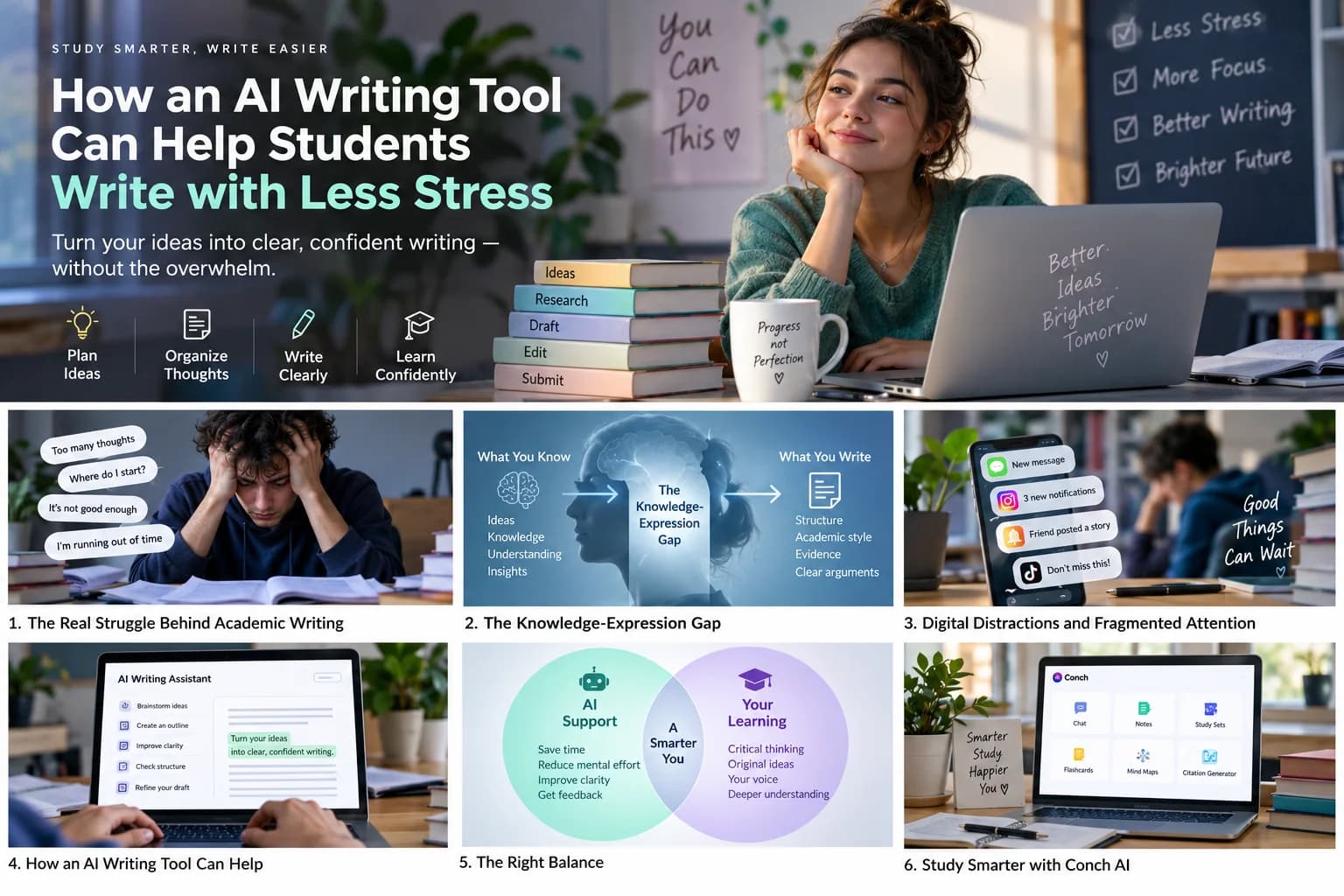
How the Right AI Writing Tool Can Reduce Academic Stress and Help Students Work Smarter

Pragya
⚡TL;DR Key Takeaways
- Discover how an AI writing tool for students can reduce academic friction, support research and writing, and help college students work more productively.
- Academic stress is not always caused by how much you have to learn.
- Sometimes, it comes from the effort required to turn what you know into organized research, clear writing, accurate citations, and work you feel confident submitting.
Table of contents31 sections
Academic stress is not always caused by how much you have to learn. Sometimes, it comes from the effort required to turn what you know into organized research, clear writing, accurate citations, and work you feel confident submitting.
There is a particular kind of frustration that many college students know well. You attend the lectures, complete the readings, highlight the important sections, and spend enough time with a subject to feel that you understand it.
Then you open a blank document.
Suddenly, understanding the topic and explaining it clearly feel like two different skills.
You know what you want to say, but the words do not seem to reflect the idea in your mind. You rewrite the introduction, question your argument, open another research paper for reassurance, and remember that several citations still need attention.
Meanwhile, the deadline is getting closer, your phone is competing for your attention, and an assignment that seemed manageable a week ago now feels overwhelming.
Free Readability and Tone Diagnostic
Check if your draft sounds natural and clear. Paste a paragraph below to simulate readability scoring and tone analysis.
This experience does not always mean you failed to learn the material. Often, it means the academic process is asking you to manage too many tasks at once.
That is why an AI writing tool for students should do more than generate sentences. A useful academic tool should reduce friction between understanding, researching, organizing, writing, citing, revising, and studying.
The goal is not to remove thinking from academic work. Instead, the goal is to leave students with more attention for the thinking that matters.
Why Does Academic Work Feel So Mentally Exhausting?
A research paper may appear on your syllabus as one assignment. In reality, it contains many smaller tasks.
You have to understand the instructions, find credible sources, read them carefully, take notes, decide what matters, build an argument, organize the evidence, write clearly, manage citations, revise the paper, and follow your professor’s requirements.
At the same time, that paper is rarely your only responsibility. You may also be preparing for a midterm, completing another assignment, working part-time, attending classes, and managing personal commitments.
As a result, the problem is not always a lack of time. Sometimes, it is a lack of usable attention.
This distinction matters because common productivity advice often tells students to do more. Students are encouraged to study longer, wake up earlier, create stricter schedules, or become more disciplined.
Those habits can help. However, they do not solve every source of academic stress.
Sometimes, students are already working hard. Too much of their energy is simply being spent managing the process rather than completing the intellectual work.
The Knowledge-Expression Gap: When You Know More Than Your Paper Shows
One of the most frustrating academic experiences is receiving a grade that does not seem to reflect how well you understood the subject.
You may understand a theory when your professor explains it. You may also be able to discuss it with a classmate or recognize a good example.
However, an academic paper requires more than understanding.
You must turn that understanding into a structured argument, choose appropriate academic language, integrate evidence, follow academic conventions, and make your reasoning clear to someone who cannot see what you were thinking.
This creates what we can call the knowledge-expression gap.
It is the distance between what a student understands and what they can communicate successfully in academic writing.
Recent research supports this distinction. A 2026 study of university students writing in English as a foreign language found that academic writing involves several challenges at once. These included organizing arguments, integrating evidence, following academic conventions, and managing language demands.
Importantly, this problem is not limited to international students. A 2026 study of native English-speaking university students also challenged the assumption that everyday language fluency automatically leads to confidence in academic writing.
In other words, knowing English and knowing how to communicate an academic argument are not exactly the same skill.
This matters because students often respond to writing difficulty by doing more research.
Sometimes, more research is necessary. However, a student may already understand the subject and still struggle to communicate that knowledge effectively.
Imagine that your understanding feels like an eight out of ten, but your paper communicates only a five. The argument may be poorly organized, the evidence may not connect clearly, or the language may fail to express the nuance you intended.
Your professor cannot grade the argument that exists in your mind. They can only assess what reaches the page.
Sometimes students do not need more knowledge. They need a clearer bridge between what they know and what they can express.
This challenge can become even more noticeable for international students. They may be deciding what they want to argue while also deciding how to express that argument naturally in academic English.
A good AI writing tool should help narrow this gap without taking ownership of the student’s ideas.
Procrastination Is Not Always a Time-Management Problem
Students are often told that procrastination happens because they lack discipline. Therefore, the obvious advice is to start earlier.
Sometimes that advice is useful. Yet recent research suggests that academic procrastination is more complicated.
A 2026 systematic review of 27 studies identified several factors associated with academic procrastination. These included fear of failure, perfectionism, test anxiety, low motivation, and difficulties with emotional regulation.
This helps explain why a student may know that an essay is due next week and still struggle to begin.
From the outside, the task looks simple: write the paper.
Inside the student’s mind, however, the task may involve several unresolved questions. Is the argument strong enough? Have I found enough evidence? Did I understand the prompt correctly? Does the introduction sound academic enough?
When these questions remain unresolved, the assignment begins to feel larger than its word count.
Avoidance provides temporary relief. Unfortunately, it also reduces the time available to complete the work.
As the deadline approaches, pressure increases. Students may then rush research, make weaker decisions, and worry even more about the final result.
The cycle often looks like this:
uncertainty → avoidance → less time → greater pressure → rushed work → more uncertainty
Instead of asking only, “Why am I procrastinating?” ask a more practical question:
What part of this assignment still feels too unclear, uncomfortable, or large to begin?
Once the problem becomes specific, it is usually easier to address.
Why Leaving Citations Until the End Creates More Work
Citations are another common source of avoidable academic stress.
You find a useful paper, copy an idea into your notes, and tell yourself that you will format the citation later.
Then you do the same with another source.
By the end of the evening, your document contains useful ideas, quotations, PDFs, and browser tabs. However, you may no longer remember which source supports each claim.
A small shortcut has now created additional work.
A better approach is to capture the source when you capture the idea.
You do not need to create the final APA, MLA, or Chicago citation immediately. Still, you should save enough information to identify the source and understand why you planned to use it.
Citation tools can make formatting easier. However, they cannot determine whether a source is credible or whether you have represented the author’s argument accurately.
Technology can assist with formatting. Academic judgment still belongs to the student.
When More Research Becomes a Form of Procrastination
Research can also become a surprisingly convincing form of avoidance because it feels productive.
You tell yourself that you need one more article before you begin writing. That article introduces another concept, which leads to another paper, which leads to another search.
Soon, your reference folder is growing while your draft remains almost empty.
The reason is understandable. Research allows you to collect possibilities. Writing forces you to make decisions.
At some point, you have to decide what your argument is, which evidence matters, what can be excluded, and how the ideas fit together.
Those decisions often feel more uncomfortable than opening another browser tab.
A stronger workflow separates exploratory research from targeted research.
At first, research broadly enough to understand the topic and form a working position. Then begin writing.
After that, return to research when the draft reveals a specific gap. For example, you may need stronger evidence, an original source, or a credible counterargument.
Research should gradually become a response to questions created by your argument. It should not become a way to postpone the argument itself.
FOMO, Notifications, and the Cost of Fragmented Attention
Students are also trying to complete difficult academic work in an environment where attention is constantly being requested.
A paragraph becomes difficult, so you check one notification. That message leads to another app, which leads to a group chat or social post.
When you return to the paper, you have to rebuild the line of thought you were working through.
A 2026 study of 1,071 university students found that fear of missing out was positively associated with problematic social-media use and poorer sleep quality. Problematic social-media use was also negatively associated with academic productivity.
Because the study was cross-sectional, it shows associations rather than proving direct causation.
Even so, the practical lesson is useful.
Students do not necessarily need to remove every social app from their lives. However, they should recognize that attention is part of their academic workload.
When every difficult moment becomes a reason to change context, meaningful writing becomes harder.
Therefore, one of the simplest productivity strategies is to give demanding work enough uninterrupted time to become manageable.
Perfectionism Can Make the First Draft Harder Than It Needs to Be
Another source of pressure appears when students expect the first draft to sound like the final paper.
You write a sentence, decide that it does not sound sophisticated enough, delete it, and try again. After twenty minutes, you may have produced almost nothing.
The problem is not necessarily a lack of effort. Instead, you are asking the first draft to perform the job of the final draft.
Early writing has a simpler purpose: it makes your thinking visible.
Once the argument exists on the page, you can inspect it, reorganize it, question it, strengthen it, and rewrite it.
When the idea remains entirely in your head, none of those improvements are possible.
You cannot revise an argument that you have never allowed yourself to write.
This is one area where an AI writing tool can help when students use it carefully.
For example, a tool might help organize rough notes, suggest a clearer structure, or show where a sentence has become difficult to understand.
The important question is whether the tool supports the student’s reasoning or replaces it.
Can an AI Writing Tool Actually Reduce Mental Effort?
Recent research makes this question especially interesting.
A 2026 experimental study published in Computers and Education Open examined academic writing with and without ChatGPT assistance.
Students who used AI reported lower cognitive load and greater perceived ease and control. The researchers also observed improvements in several writing-quality measures within the study setting.
These findings suggest that AI may offer value beyond faster text generation.
For students, the more useful question may be:
Can this tool remove enough unnecessary mental effort that I have more attention available for evidence, reasoning, and revision?
That distinction is important.
Reducing repetitive work can support learning. However, reducing the thinking itself can work against the purpose of an academic assignment.
Therefore, the best use of AI is often to support the process around thinking rather than perform the thinking for the student.
Productivity Is Not the Same as Being Busy
Students often measure productivity through visible activity. They count hours spent studying, pages written, sources collected, or tasks completed.
However, not every academic task contributes equally to the final outcome.
You can spend an hour adjusting formatting while avoiding a weak argument. You can collect ten more sources even though you already have enough evidence to begin drafting.
Meanwhile, another student may spend forty focused minutes improving a thesis and make much more meaningful progress.
A better definition of student productivity is therefore:
making the most meaningful academic progress with the time and attention available to you.
Once productivity is defined this way, prioritization becomes an important part of stress management.
When every unfinished task feels equally important, everything feels urgent. When priorities become visible, the workload becomes easier to approach.
The C.A.L.M. Framework for Academic Stress and Productivity
The C.A.L.M. framework can help students turn a confusing workload into a sequence of clearer decisions.
C — Capture Everything Competing for Your Attention
Start by moving unfinished academic tasks out of your head and into one reliable place.
Instead of writing only “research paper,” identify what the assignment actually contains. You may need to complete research, notes, a thesis, an outline, body sections, citations, revision, proofreading, and final submission.
Include other competing responsibilities as well, such as exam preparation, readings, group work, and smaller assignments.
The purpose is not to create a longer to-do list. Instead, it is to replace the vague feeling that something has been forgotten with a clear picture of what actually needs attention.
A — Assess What Deserves Attention First
Next, decide which task deserves your attention now.
Consider the deadline, academic impact, amount of focused work required, and whether another task depends on it.
For example, a major research paper due tomorrow should receive more attention than optional formatting improvements on an assignment due next week.
Prioritization does not mean ignoring responsibilities. It means recognizing that your time and attention are limited.
L — Lower the Barrier to Starting
Large assignments become easier to approach when the next action becomes specific.
“Write my psychology paper” describes an entire project.
A better instruction would be, “Write a temporary thesis based on my current research.”
After that, you might identify three claims that support the thesis, connect one credible source to each claim, and draft the easiest body paragraph first.
The assignment has not become smaller. However, the decision required to begin has become much clearer.
M — Match the Tool to the Actual Problem
Before opening an AI writing tool, identify the type of friction you are experiencing.
If a research paper is difficult to understand, you have a comprehension problem. If your notes are scattered across several files, you have an organization problem.
Similarly, if you understand the argument but cannot express it clearly, you have an expression problem. If you cannot remember what you studied, you may need retrieval practice.
The most useful tool is not necessarily the one with the largest feature list. It is the one that solves the problem currently slowing you down.
Why the Best AI Writing Tool for Students May Need to Do More Than Write
Traditional writing tools focus mainly on the document itself. They check grammar, rewrite sentences, adjust tone, or generate text.
However, academic work begins long before the first paragraph.
Students may need to understand difficult sources, organize lecture notes, compare research, identify relationships between concepts, develop a thesis, and plan an argument.
Likewise, the work does not end when the essay is drafted. Students still need to verify citations, improve clarity, review the rubric, and sometimes use the same material to prepare for an exam.
As a result, a useful AI writing tool for students may need to function more like a broader study environment.
A productive academic workflow looks less like:
prompt → generated paragraph
and more like:
understand → organize → research → argue → write → verify → revise → study
This broader workflow matters because students can lose time and attention when each academic task requires a completely separate application.
Integration is useful when it reduces unnecessary movement between tools without removing the student from the learning process.
What Should an AI Writing and Study Tool Help With?
| Student challenge | Helpful capability | Student responsibility |
| Difficult research paper | Document Q&A or explanation | Check the original source |
| Scattered notes | Structured note organization | Decide what matters |
| Disconnected concepts | Mind maps | Verify relationships |
| Exam preparation | Flashcards and study sets | Practice active recall |
| Blank-page anxiety | Outline support | Develop the argument |
| Academic-English difficulty | Clarity and language feedback | Preserve meaning and voice |
| Complex research | Source organization | Evaluate the evidence |
| Citation workload | Citation tools | Verify bibliographic details |
| Unclear draft | Readability diagnostics | Judge whether changes improve the paper |
| Too many separate apps | Integrated workflow | Decide how each tool should be used |
The principle behind these examples is simple:
Use technology to reduce friction, not judgment.
What a More Connected Academic Workflow Looks Like
Imagine that you have a history research paper due on Friday and a midterm the following Monday.
You begin with the professor’s prompt and the research you already collected. One journal article is difficult, so you use a document tool to clarify the author’s central argument.
Next, you organize the useful ideas into notes and identify the relationships among the main concepts.
Because some of the same material will appear on the midterm, you convert the most important concepts into flashcards for later review.
Then you return to the research paper. Your notes help you develop a working thesis and outline. You connect sources to the sections where you plan to use them, which reduces the risk of rebuilding citations later.
Once the first draft is complete, you check the evidence, revise unclear language, verify citations, and compare the paper with the rubric.
Technology has supported several stages of the process. However, the student still decides what the evidence means, which argument to make, and what belongs in the final paper.
That is the difference between using AI as a shortcut and using it as an academic support system.
Where Conch AI Fits Into This Workflow
This broader academic workflow is also a useful way to understand Conch AI.
Students may first discover Conch while looking for an AI writing tool. However, the current platform connects writing with several other parts of academic work, including source comprehension, notes, study materials, research organization, and revision.
For example, Conch Chat allows students to work with uploaded documents and ask questions about their content. This can be useful when a difficult PDF, article, or presentation needs to be understood before it can be used effectively in an assignment.
Conch Notes can turn textbooks, articles, transcripts, and research papers into structured, editable notes. Students can then revise those notes or reuse them in other parts of their study workflow.
Study Sets connect notes with flashcards and mind maps created from the same source material. Therefore, a reading used for an essay can also become useful material for exam preparation.
The flashcard and mind-map tools support different learning needs. Flashcards can support active recall, while mind maps can help students understand how ideas relate to one another.
On the writing side, Conch supports outlining, academic drafting, research-paper workflows, rewriting, citation assistance, and writing diagnostics.
For students experiencing the knowledge-expression gap, language and readability support can be especially useful. The goal is not to replace the student’s ideas with generic academic language. Instead, the tool can help determine whether the written sentence communicates the intended idea clearly.
Conch also provides citation support for common U.S. academic styles, including APA, MLA, and Chicago. This can reduce repetitive formatting work, although students should still verify every important source and reference.
The larger benefit is not that one platform can complete every academic task automatically. Rather, related stages of academic work can remain connected.
A student can move from understanding material to organizing it, developing an argument, writing, revising, and studying without rebuilding the same context repeatedly.
What AI Should Not Take Over
As AI tools become more capable, students need clearer boundaries around what should remain their responsibility.
Your argument should remain yours. AI can help test a structure or identify an unclear connection, but it should not decide what you believe.
Your evidence judgment should also remain yours. A tool can help organize sources, but you still need to decide whether those sources are credible and relevant.
Most importantly, your understanding should remain yours. A simplified explanation can help you learn, but you should eventually be able to explain the idea without repeating generated language.
The final submission is also your responsibility. You need to verify facts, citations, course requirements, and your instructor’s rules on AI use.
Different colleges and even different professors within the same institution can set different policies.
Therefore, the important question is not simply whether AI can complete a task.
Instead, ask:
If AI completes this part for me, am I still doing the learning that the assignment is meant to assess?
A 10-Minute Reset When Academic Work Feels Overwhelming
When several deadlines are competing for your attention, trying to solve everything at once usually creates more stress.
First, spend two minutes writing down every unfinished academic task. Then identify the deadline that matters most.
Next, define the deliverable precisely. “Work on history” is vague, while “complete a 1,500-word comparative essay using five scholarly sources in MLA style” creates a clear target.
After that, identify what is actually blocking progress. You may be missing knowledge, research, structure, language, citations, or simply a clear first step.
Break the work into stages, such as research, thesis, outline, evidence, draft, citations, revision, and final review.
Only then decide whether a tool can help.
If the problem is comprehension, use a tool for comprehension. If the problem is organization, organize the material. If the issue is language, focus on revision.
However, if you still do not know what you think, give yourself time to develop the argument before asking AI to generate one.
Finally, remove the most obvious distractions and begin with one useful task that can be completed in the next twenty or thirty minutes.
The objective is not to solve the whole semester at once. It is to make the next academic decision manageable.
How to Choose an AI Writing Tool for Students
Before choosing another academic tool, consider the stage where you actually struggle.
A useful AI writing tool for students should help you understand difficult material, organize research, improve clarity, and manage repetitive academic tasks without taking control of your reasoning.
It should also allow you to trace important information back to the original source, edit generated material, and verify citations.
If you regularly use APA, MLA, or Chicago style, citation support may also matter. Likewise, students who use the same material for both assignments and exams may benefit from tools that connect notes, writing, and study resources.
Most importantly, choose a tool that encourages verification rather than making the student feel unnecessary.
The best AI writing tool is not necessarily the one that generates the longest essay. It is the one that removes unnecessary friction while keeping the student involved in the learning process.
The Best AI Writing Tool Should Give You More Attention, Not Just More Words
AI writing tools are often evaluated by how much they can produce and how quickly they can produce it.
For students, however, there is a more useful question:
What happens to your attention after you begin using the tool?
If technology reduces the time spent reorganizing scattered notes, reconstructing forgotten citations, correcting repeated language problems, or switching between unrelated apps, students can redirect that attention toward more meaningful academic work.
They may have more time to read a source carefully, question weak evidence, strengthen an argument, prepare for an exam, or check whether they genuinely understand a difficult concept.
That does not make an AI writing tool a treatment for academic stress or mental-health conditions.
However, it does show how academic productivity and student wellbeing can overlap.
Avoidable friction consumes attention. Better systems can return some of it.
The best AI writing tool does not save you from thinking. It saves more of your attention for the thinking that matters.
A healthier definition of productivity follows from that idea.
The goal is not to generate as much work as possible while constantly feeling behind. Instead, the goal is to create an academic workflow in which research has a place, ideas have structure, sources remain connected to evidence, and writing accurately reflects what the student understands.
When the distance between learning something and showing what you learned becomes smaller, academic work begins to feel less like one enormous problem and more like a series of manageable decisions.
Frequently Asked Questions
Can an AI writing tool reduce academic stress?
An AI writing tool can reduce specific sources of academic friction, such as organizing notes, understanding difficult material, creating an outline, improving language, or formatting citations. However, an AI tool should not be presented as a treatment for anxiety, depression, or other mental-health conditions.
Can AI improve academic writing?
Research published in 2026 suggests that AI-assisted writing can improve some aspects of writing in specific settings. One experimental study also reported lower cognitive load and greater perceived ease and control among students using ChatGPT during academic-writing tasks. However, the value of AI depends heavily on how students use it.
What is the best AI writing tool for college students?
There is no single best tool for every student. Some students need academic-English support, while others need help with research organization, source comprehension, citations, notes, or exam preparation. The right tool should match the student’s actual bottleneck.
Can AI help with research papers?
AI can support research-paper workflows by helping students understand difficult sources, organize notes, build outlines, review language, and format references. Students should still choose and evaluate evidence, interpret sources, develop arguments, and verify the final paper.
Is it okay to use AI for college assignments?
AI policies vary by institution, course, professor, and assignment. Students should review the syllabus and instructor guidance before using generative AI for graded work.
What is the difference between an AI writing tool and an AI study tool?
An AI writing tool generally focuses on drafting, rewriting, grammar, and editing. An AI study environment may also include document comprehension, notes, flashcards, mind maps, research organization, and study planning. Increasingly, these categories overlap.
Final Thought
One of the most frustrating experiences in college is working hard to understand a subject and still feeling unable to show that understanding clearly in an assignment.
The answer is not always to study longer. Sometimes, the student needs a better structure, a clearer next step, more organized research, stronger source management, or support expressing an idea that is already understood.
A well-designed academic tool can reduce some of that repetitive friction. When it does, students have more time and attention for understanding evidence, developing arguments, making academic judgments, and communicating ideas in their own voice.
Technology should make those parts of academic work easier to reach.
It should not replace them.
If scattered notes, research, citations, and writing are creating unnecessary friction, Conch can help connect those stages in one academic workflow. Students should still review every final result against their sources, assignment rubric, course requirements, and their own understanding before submitting it.
Related Reading
- How to Calculate H Index
- How to Write an Informative Essay
- Technology Essay
- How to Write a Header for an Essay
- How to Write a Biography Essay
- How to Write a Reflection Paper
- How to Write an Encyclopedia Entry
- Speech Analysis Example
- What is a Good H Index
- Why Is My Essay Being Flagged as AI? 11 Reasons—and What to Do
- Humanized AI Writing Is More Than AI Detection
- How to Improve Academic English: A Practical Guide for International Students

About the Author: PragyaVerified Editor
Academic Policy Specialist & AI Ethics Researcher
Pragya is a learning specialist and content editor focusing on student productivity, academic integrity, and responsible AI integration. They hold extensive experience guiding students through research standards, citation guidelines, and text refinement workflows.